



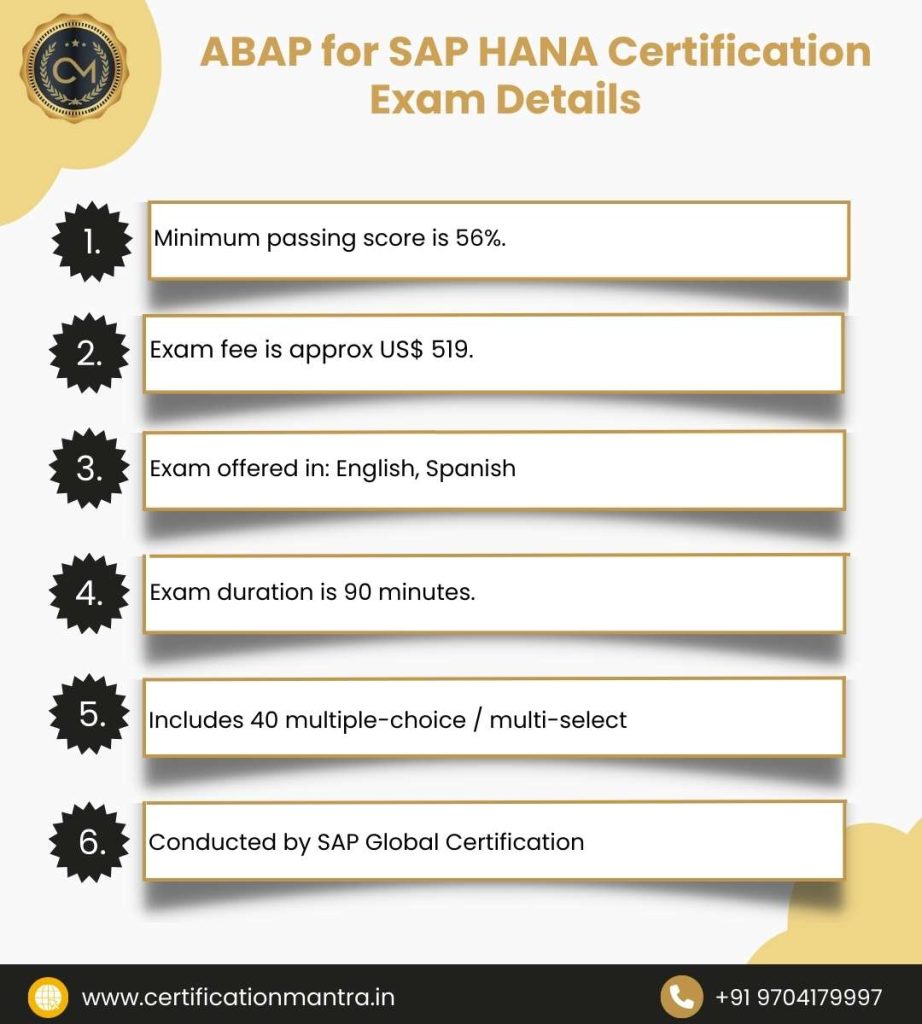
- Register through SAP’s official certification portal with a valid account.
- Choose the ABAP for SAP HANA exam code based on the latest release.
- Pick your preferred exam slot and verify system requirements.
- Complete the payment through the SAP Training and Certification Shop.
- Take the exam online using SAP’s proctored environment.
- Ensure your webcam, microphone, and system meet exam guidelines.
- Follow identity verification steps during exam check-in.
- Submit answers within the given duration and review if time allows.
- Download your result and digital badge after clearing the exam successfully.
Frequently Asked Questions

- ABAP for SAP HANA is an enhanced version of ABAP optimised to work with SAP HANA’s in-memory database. It focuses on performance-driven development using new tools and concepts. Developers use it to build fast, scalable, and modern SAP applications.
- It enables developers to use the power of SAP’s in-memory computing for better performance. Traditional coding techniques are improved with code-to-data principles. This ensures optimised, real-time business applications.
- You need basic ABAP knowledge and understanding of databases. Familiarity with SQL and object-oriented programming helps. Prior SAP experience strengthens learning.
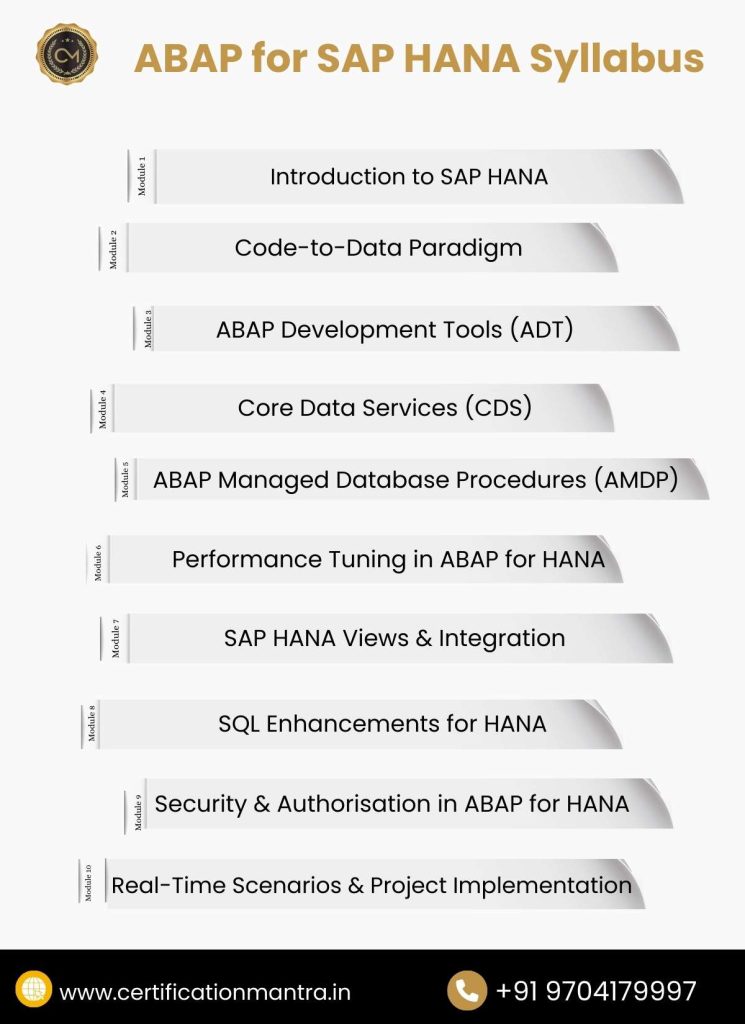
- Core Data Services (CDS) views are semantic data models created at the database level. They help shift logic to HANA for faster execution. CDS supports annotations, joins, and advanced modelling features.
- ABAP Managed Database Procedures allow developers to write database-specific logic. They run directly on SAP HANA for improved performance. AMDP uses SQLScript and supports code-to-data processing.
- This approach shifts heavy data processing from the ABAP layer to the HANA database. It reduces data transfer and improves speed. The goal is efficient, optimised application performance.
- ABAP developers, SAP technical consultants, and database programmers benefit most. Professionals upgrading from ECC to S/4HANA need it. It’s also great for freshers aiming for SAP careers.
- It’s easier if you already know ABAP fundamentals. The new HANA concepts need practice but are structured well. With hands-on coding, learning becomes smooth.
- Developers use Eclipse with ABAP Development Tools (ADT). SAP GUI supports traditional workbench tasks. The combination provides a modern, powerful development environment.
- SQLScript is HANA’s advanced SQL language for complex calculations. It supports loops, conditional logic, and high-performance operations. AMDP and procedures commonly use SQLScript.
- Annotations enhance metadata for CDS models. They define behaviour, UI, analytics, and OData settings. They make CDS powerful, flexible, and framework-ready.
- It uses in-memory data processing, which reduces response time. Logical operations happen closer to the database. Applications become faster, smarter, and more scalable.
- ADT is a plugin for Eclipse used for modern ABAP development. It provides advanced editors, debugging tools, and performance checkers. It is essential for HANA-based projects.
- Yes, SAP S/4HANA continues to use ABAP as its core programming language. However, it requires optimised HANA-based coding standards. Developers must follow new guidelines for high performance.
- A Calculation View is a model created within SAP HANA. It supports advanced analytics and complex transformations. ABAP interacts with these views for high-speed data retrieval.
- Certification is optional but highly beneficial. It validates your technical expertise and improves job opportunities. Many employers prefer certified professionals for HANA projects.
- The exam includes scenario-based questions on CDS, AMDPs, SQLScript, and HANA concepts. It tests your ability to optimise and build HANA-ready applications. Practical understanding is essential to clear it.
- Most learners take 4–8 weeks with consistent practice. Real-time exercises speed up understanding. Project exposure helps strengthen concepts.
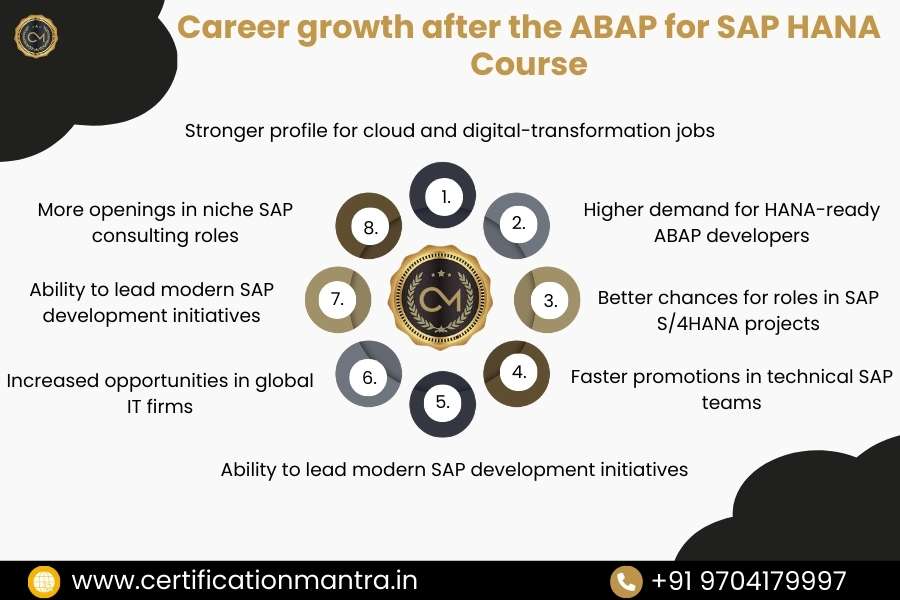
- Absolutely, as SAP S/4HANA adoption grows globally. Companies need developers skilled in modern ABAP techniques. It offers long-term stability and high career growth.
- You can work as an ABAP Developer, SAP HANA Consultant, or S/4HANA Technical Developer. Advanced learners move into solution architect roles. Freelancing and remote jobs are common, too.
- Industries like retail, manufacturing, healthcare, finance, and logistics demand these skills. Any SAP-enabled organisation benefits from HANA-optimised development. The demand is global and consistent.
- Yes, SAP GUI is still used for some traditional tasks. However, ADT in Eclipse is the primary tool for modern development. A combination of both creates a complete workflow.
- CDS views provide faster, cleaner, and reusable data models. Many analytical reports now prefer CDS-based logic. But traditional reports still exist where needed.
- Basic SQL is important because HANA uses database-driven logic. Many operations depend on joins, filters, and SQLScript. Learning SQL improves your coding performance.
- Table functions represent reusable functions that return tables. They are written using SQLScript inside AMDP. They help build complex, database-optimised logic.
- ABAP developers convert old ECC logic into HANA-optimised code. They refactor reports, remove obsolete code, and build new CDS models. It’s a critical role in migration projects.
- It involves optimising queries, minimising loops, and using HANA-friendly design. Tools like ATC and SQL Monitor help detect issues. The goal is to deliver faster, leaner applications.
- Yes, freshers with programming basics can learn it easily. Starting with core ABAP is helpful. With proper training, they can enter SAP projects quickly.
- Practical labs help you understand real project scenarios. Hands-on coding builds confidence and clarity. It makes certification and job interviews easier.
- It delivers better performance through in-memory computing and modern frameworks. It supports new-age technologies like Fiori, OData, and S/4HANA. It ensures your skills remain relevant in the evolving SAP ecosystem.