ISTQB CERTIFICATION TRAINING IN HYDERABAD
Crack ISTQB Certification in First Attempt
Next Batch: 2 November 2026
Certification Mantra is a Hyderabad-based training institute that provides ISTQB certification training with clear and structured guidance. The program focuses on practical learning, exam preparation, and building the confidence needed for long-term career growth in software testing.
100% Pass Guarantee
We guarantee your success! With our unique methodologies and constant assessment
Crack in First Attempt
We don't cut any corners when it comes to providing you the best training.
Certified Trainers
All our trainers are certified and have a proven track record of providing high-quality training.
What is ISTQB Certification?
- ISTQB (International Software Testing Qualifications Board) is a globally recognized body for certifying software testing professionals.
- The ISTQB certification is designed to standardize the knowledge and skills of software testers across industries.
- It is structured into Foundation, Advanced, and Expert levels to support career growth at all stages.
- The certification is recognized in over 130 countries, including top IT hubs like Hyderabad, Bangalore, Pune, and Chennai.
- Companies across the globe, including MNCs and startups in Hyderabad, value ISTQB certification while hiring QA professionals.
- ISTQB certification enhances your employability, credibility, and salary prospects in the software testing domain.
- This certification aligns with industry best practices, including Agile, DevOps, and Quality Assurance standards.
ISTQB Certification Training overview
ISTQB Certification Training in Hyderabad is a great choice for students and professionals who want to build a career in software testing. The training covers key topics like SDLC, STLC, defect lifecycle, and test case design with practical examples for better understanding.
As Hyderabad is a major IT hub, an ISTQB certification adds strong value to a resume and improves job opportunities. The program also includes mock tests and exam guidance to help candidates prepare well and grow in their careers.
What is ISTQB Certification used for?
- ISTQB stands for International Software Testing Qualifications Board, a globally recognized body for software testing certifications. It was created to establish universal standards in software testing knowledge and best practices.
- The board offers a range of certifications that assess a professional’s understanding of software testing concepts, methods, and techniques. ISTQB certifications are available worldwide, and individuals can register through their country-specific boards to take the exams.
- The certification structure supports testers at all levels, from beginners to advanced professionals. Specialized working groups within ISTQB develop and update certification syllabi and exam content to match current industry needs. These updates ensure that the certifications stay relevant to evolving software development practices like Agile and DevOps.
- ISTQB Certification Training in Hyderabad provides an excellent opportunity for professionals to start or upgrade their careers in software testing. The training is designed to help individuals solidify their testing knowledge and apply best practices in real-world projects.
- It’s ideal for both newcomers and experienced testers who want to gain a globally accepted credential in the QA field.

Why Choose us?
Hands on Practice
Hands-on lab exercises with detailed answers.
Highly Qualified Trainers
Expert team of highly qualified faculty members.
Best Support
Support provided by our friendly support team
Guidance from Experiences Instructors
Guidance throughout the entire course from highly experienced instructors who are there to help you at every step of the way.
Real-life Case Studies
Realistic and relevant case studies that you can relate to your own projects.
Why Should You Take ISTQB Certification Training in Hyderabad?
A certified ISTQB Professional will have a distinct advantage when competing for jobs against non-certified testing professionals. ISTQB certification in Hyderabad will help you advance your career by demonstrating your knowledge and expertise in the field of software testing. With more than 400,000 certified professionals worldwide, this is a professional credential that is widely respected and has a very positive impact on your opportunities for career advancement with an average salary of 6.22 LPA in India.
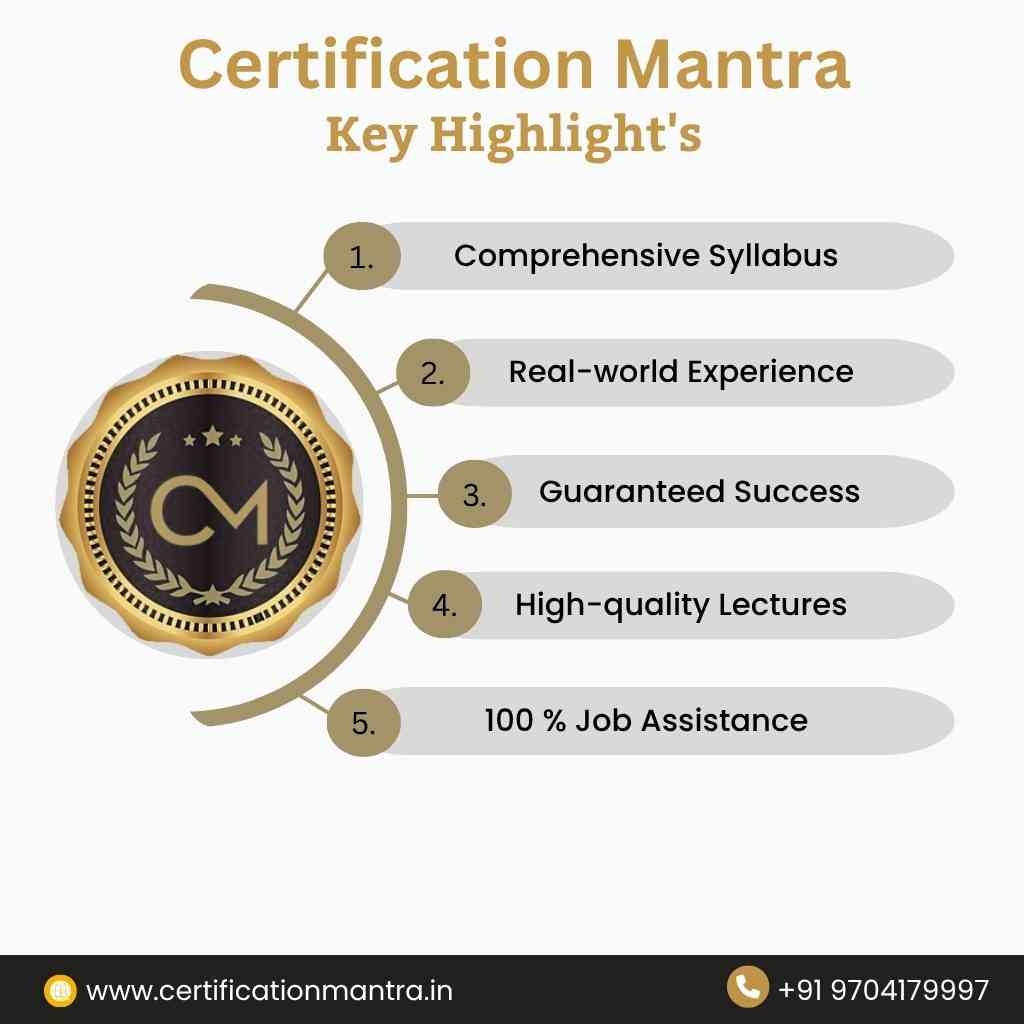
Key Highlights of ISTQB Training
- Comprehensive Syllabus
- Real-world Experience
- Guaranteed Success
- Lifetime access to recorded lectures and materials
- High-quality Lectures
- Learn at Your Convenience
- 100 % Job Assistance
ISTQB Course Curriculum
What is testing?
- Identify typical objectives of testing
- Differentiate testing from debugging
Why is Testing Necessary?
- Give examples of why testing is necessary
- Testing’s Contributions to Success
- Quality Assurance and Testing
- Errors, Defects, and Failures
- Defects, Root Causes and Effects
Seven Testing Principles Test Process
- Test Process in Context
- Test Activities and Tasks
- Test Work Products
- Traceability between the Test Basis and Test Work Products
The Psychology of Testing
- Human Psychology and Testing
- Tester’s and Developer’s Mindsets
- Software Development Lifecycle Models
- Software Development and Software Testing
- Software Development Lifecycle Models in Context
Test Levels
- Component Testing
- Integration Testing
- System Testing
- Acceptance Testing
Test Types
- Functional Testing
- Non-functional Testing
- White-box Testing
- Change-related Testing
- Test Types and Test Levels
Maintenance Testing
- Triggers for Maintenance
- Impact Analysis for Maintenance
What is testing?
- Identify typical objectives of testing
- Differentiate testing from debugging
Why is Testing Necessary?
- Give examples of why testing is necessary
- Testing’s Contributions to Success
- Quality Assurance and Testing
- Errors, Defects, and Failures
- Defects, Root Causes and Effects
Seven Testing Principles Test Process
- Test Process in Context
- Test Activities and Tasks
- Test Work Products
- Traceability between the Test Basis and Test Work Products
The Psychology of Testing
- Human Psychology and Testing
- Tester’s and Developer’s Mindsets
- Choosing Test Techniques
- Categories of Test Techniques and Their Characteristics
Black-box Test Techniques
- Equivalence Partitioning
- Boundary Value Analysis
- Decision Table Testing
- State Transition Testing
- Use Case Testing
White-box Test Techniques
- Statement Testing and Coverage
- Decision Testing and Coverage
- The Value of Statement and Decision Testing
Experience-based Test Techniques
- Error Guessing
- Exploratory Testing
- Checklist-based Testing
- Identify typical objectives of testing
- Differentiate testing from debugging
Why is Testing Necessary?
- Give examples of why testing is necessary
- Testing’s Contributions to Success
- Quality Assurance and Testing
- Errors, Defects, and Failures
- Defects, Root Causes and Effects
Seven Testing Principles Test Process
- Test Process in Context
- Test Activities and Tasks
- Test Work Products
- Traceability between the Test Basis and Test Work Products
The Psychology of Testing
- Human Psychology and Testing
- Tester’s and Developer’s Mindsets
- Introduction
- Test Planning, Monitoring and Control
- How Test Strategies effects test planning
- Test Planning
- Test Monitoring and Control
- Test Analysis and Test Design (apply primarily for test analyst)
- Test Implementation and Execution
- Preconditions for test Implementation
- Advantages and disadvantages of early test Implementation
- Evaluating Exit Criteria and Reporting
- Information necessary to collect during test process to support accurate reporting and evaluation against exit criteria
- Test Closure Activities
- Case studies ,Debrief and Mock test
- Introduction
- Test Management in Context
- Understanding Testing Stakeholders
- Additional Software Development Lifecycle Activities and Work Products
- Alignment of Test Activities and Other Lifecycle Activities
- Managing Non Functional Testing
- Managing Experience-Based Testing
- Case studies , Debrief and Mock test
- Risk-Based Testing and Other Approaches for Test Prioritization and Effort Allocation
- Different ways Risk-Based Testing responds to risk
- Risk-Based Testing Activities
- Risk Identification techniques
- Risk Assessment Techniques
- Risk Mitigation Activities
- Risk Based Techniques
- Informal approaches
- Pragmatic risk analysis and management (PRAM)
- Systematic software testing (SST)
- Formal approaches
- Hazard Analysis
- Cost of Exposure
- Failure Mode and Effect Analysis (FMEA)
- Quality Function Deployment (QFD)
- Fault Tree Analysis (FTA)
- Test Prioritization and Effort Allocation in the Test Process
- Test Triage
- Case studies , Debrief and Mock test
- Test Documentation and Other Work Products
- Quality Policy
- Test Handbook – Test Policy
- Test Strategy
- Master Test Plan
- Level Test Plan
- Project Risk Management
- Other Test Work Products
- Case studies , Debrief and Mock test
- Test Estimation
- Factors that can influence the cost, effort and duration of the test activity
- Factors which arise from the Process
- Factors which arise from the People
- Factors which arise from the nature of the project, tools
- Estimation techniques
- Intuition,
- Work breakdown structure
- Test Point Analysis
- Wide Band Delphi
- Predictive models (function points, LOC…)
- Defining and Using Test Metrics
- Measure Theory
- Metrics definition and selection
- Presenting measurement values
- Several Test Metrics
- Test Case based Metrics
- Test basis and test object based Metrics
- Defect Based Metrics
- Cost or Effort based Metrics
- Business Value of Testing
- Distributed, Outsourced, and Insourced Testing
- Managing the Application of Industry Standards
- Case studies , Debrief and Mock test
- Introduction
- Benefits of reviews as compared to dynamic testing
- Steps to Introduce reviews
- Change Control Board Process
- IEEE 1028 Standard for SoJware Reviews
- Types of Reviews
- Comparison
- Relative strength
- Weakness
- Fields of use
- Management Reviews and Audits
- Managing Reviews – Success factors for reviews
- Metrics for Reviews
- Managing Formal Reviews
- Case studies , Debrief and Mock test
- IEEE 1044 – Incident management life cycle
- Defect Workflow and States
- Standard classification of soJware anomalies according to IEEE 1044
- Steps and activities in each step
- Managing Invalid and Duplicate Defect Reports
- Cross-Functional Defect Management
- Defect Report Information
- Defect Metrics
- Assessing Process Capability with Defect Report Information
- Defect Taxonomy
- Case studies , Debrief and Mock test
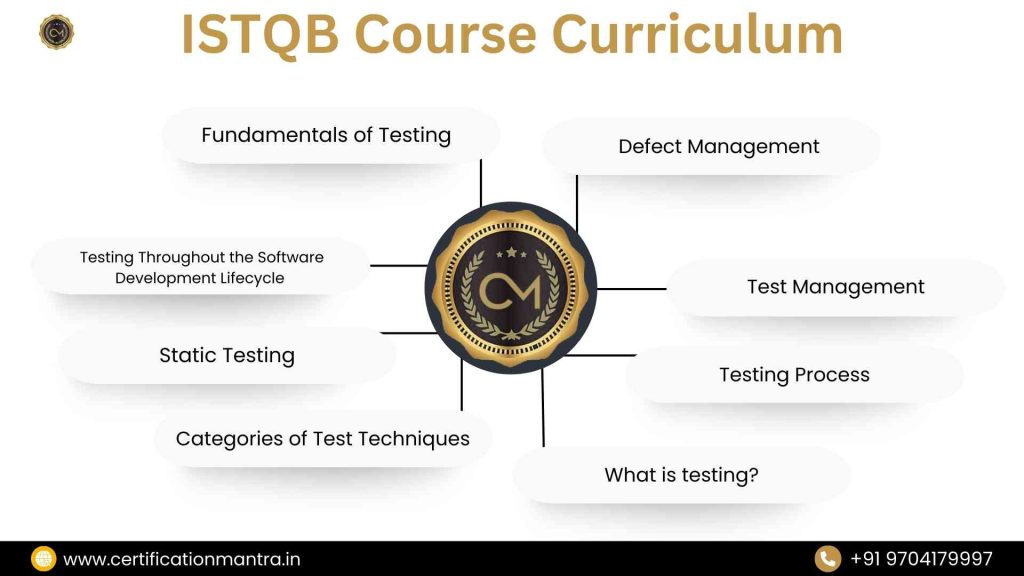
ISTQB Advanced level Syllabus
- Introduction
- Test Planning, Monitoring and Control
- How Test Strategies effects test planning
- Test Planning
- Test Monitoring and Control
- Test Analysis and Test Design (apply primarily for test analyst)
- Test Implementation and Execution
- Preconditions for test Implementation
- Advantages and disadvantages of early test Implementation
- Evaluating Exit Criteria and Reporting
- Information necessary to collect during test process to support accurate reporting and evaluation against exit criteria
- Test Closure Activities
- Case studies ,Debrief and Mock test
- Introduction
- Test Management in Context
- Understanding Testing Stakeholders
- Additional Software Development Lifecycle Activities and Work Products
- Alignment of Test Activities and Other Lifecycle Activities
- Managing Non Functional Testing
- Managing Experience-Based Testing
- Case studies , Debrief and Mock test
- Risk-Based Testing and Other Approaches for Test Prioritization and Effort Allocation
- Different ways Risk-Based Testing responds to risk
- Risk-Based Testing Activities
- Risk Identification techniques
- Risk Assessment Techniques
- Risk Mitigation Activities
- Risk Based Techniques
- Informal approaches
- Pragmatic risk analysis and management (PRAM)
- Systematic software testing (SST)
- Formal approaches
- Hazard Analysis
- Cost of Exposure
- Failure Mode and Effect Analysis (FMEA)
- Quality Function Deployment (QFD)
- Fault Tree Analysis (FTA)
- Test Prioritization and Effort Allocation in the Test Process
- Test Triage
- Case studies , Debrief and Mock test
- Test Documentation and Other Work Products
- Quality Policy
- Test Handbook – Test Policy
- Test Strategy
- Master Test Plan
- Level Test Plan
- Project Risk Management
- Other Test Work Products
- Case studies , Debrief and Mock test
- Test Estimation
- Factors that can influence the cost, effort and duration of the test activity
- Factors which arise from the Process
- Factors which arise from the People
- Factors which arise from the nature of the project, tools
- Estimation techniques
- Intuition,
- Work breakdown structure
- Test Point Analysis
- Wide Band Delphi
- Predictive models (function points, LOC…)
- Defining and Using Test Metrics
- Measure Theory
- Metrics definition and selection
- Presenting measurement values
- Several Test Metrics
- Test Case based Metrics
- Test basis and test object based Metrics
- Defect Based Metrics
- Cost or Effort based Metrics
- Business Value of Testing
- Distributed, Outsourced, and Insourced Testing
- Managing the Application of Industry Standards
- Case studies , Debrief and Mock test
- Introduction
- Benefits of reviews as compared to dynamic testing
- Steps to Introduce reviews
- Change Control Board Process
- IEEE 1028 Standard for SoJware Reviews
- Types of Reviews
- Comparison
- Relative strength
- Weakness
- Fields of use
- Management Reviews and Audits
- Managing Reviews – Success factors for reviews
- Metrics for Reviews
- Managing Formal Reviews
- Case studies , Debrief and Mock test
- IEEE 1044 – Incident management life cycle
- Defect Workflow and States
- Standard classification of soJware anomalies according to IEEE 1044
- Steps and activities in each step
- Managing Invalid and Duplicate Defect Reports
- Cross-Functional Defect Management
- Defect Report Information
- Defect Metrics
- Assessing Process Capability with Defect Report Information
- Defect Taxonomy
- Case studies , Debrief and Mock test
Modes of Training
Online Training
- Basic to advance level
- Daily recorded videos
- Capstone Project
- Internship Provided
- 100% Placement assistance
- Whatsapp Group Access
Offline Training
- Lifetime Video Access
- Basic to advance level
- Internship till you get placed
- One-One Mentorship
- Real time Industry Projects
- Interview Guidance
Corporate Training
- Basic to advance level
- Flexible Batch Timings
- Live project included
- Daily recorded videos
- Doubt Clearing Sessions
- Whatsapp Group Access
Who Can take ISTQB Training?

Software Developers

Database Developers

System Analysts

Quality Assurance (QA) Testers

Functional Testers

Regression Analysts
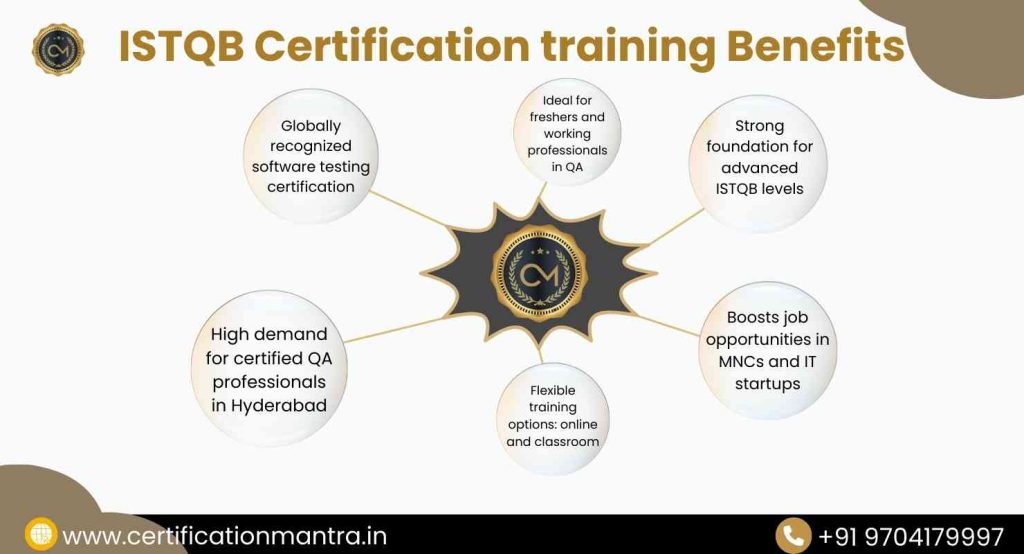
ISTQB Certification Training Benefits
- Gain a globally recognized certification that’s accepted by top IT companies in Hyderabad and worldwide
- You can improve your chances of getting hired for QA and software testing roles in Hyderabad’s growing tech sector
- You'll Learn testing skills aligned with the latest industry standards and ISTQB syllabus
- Stand out during job interviews and boost your profile for roles like Test Engineer, QA Analyst, and Test Lead
- It is Suitable for beginners, manual testers, and professionals looking to upskill or switch careers
- Flexible training options available, including online and weekend batches for working professionals
- You can Increase your salary potential and job stability with an in-demand certification
- You can build a strong foundation for pursuing advanced and expert-level ISTQB certifications in the future
- You'll Get support and training from experienced mentors familiar with Hyderabad’s local IT hiring trendsistqb
Practical Training
Mature Syllabus
Best Simulations
100% Placements
Career Opportunities and Salary After ISTQB Certification(2026)
Salaries vary based on skills and experience
Role | Experience | Approx. Annual Salary (Hyderabad) |
Software Tester / QA Analyst | 0–2 yrs | ₹3.0 LPA – ₹5.5 LPA |
Manual Tester | 1–3 yrs | ₹3.0 LPA – ₹4.5 LPA |
QA Engineer | 2–5 yrs | ₹5.0 LPA – ₹8.0 LPA |
Automation Test Engineer | 2–5 yrs | ₹3.5 LPA – ₹12 LPA |
Senior Test Engineer / QA Lead | 5+ yrs | ₹8.0 LPA – ₹14 LPA |
Test Manager / QA Manager | 7+ yrs | ₹12 LPA – ₹25 LPA + (varies by company) |
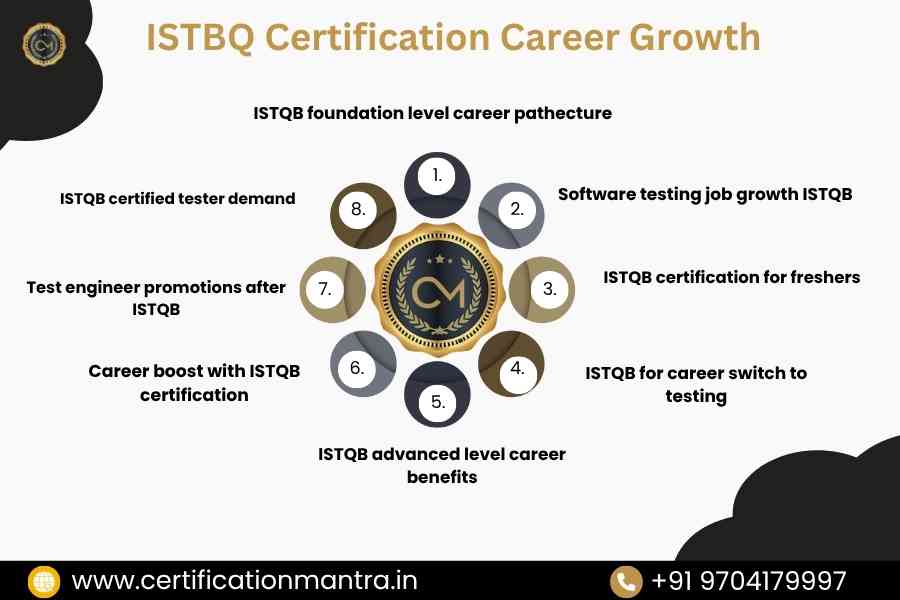
ISTQB Certification Career Growth
- ISTQB training in Hyderabad Certification opens wide range of career opportunities in the software testing field, both in India and internationally.
- Once you’re certified, you’re more likely to get shortlisted for roles like QA Analyst, Test Engineer, and Software Tester in top companies.
- With experience and additional certifications, you can move up to positions like Senior Test Engineer, Test Lead, QA Manager, or even Test Architect.
- Many MNCs and IT startups in Hyderabad specifically look for ISTQB-certified professionals while hiring for QA roles.
- The certification not only boosts your chances of getting hired but also improves your salary prospects and job stability.
- It adds credibility to your profile and gives you the confidence to work on high-level projects, often leading to leadership roles over time.
- If you’re already in testing, this certification helps you advance faster in your career path, especially when switching companies or applying for promotions.
- It’s also a great stepping stone if you plan to specialize in areas like test automation, performance testing, or Agile testing.
- ISTQB is recognized globally, so you’ll have opportunities to work with international clients or get on-site assignments.
- Whether you’re starting out or aiming for the next level, ISTQB certification gives your career in QA a strong push in the right direction.
ISTQB Certification Course Objectives
- Help learners understand the core principles and fundamentals of software testing
- Equip participants with practical knowledge of various testing techniques, levels, and types
- Prepare candidates to confidently pass the ISTQB Foundation Level Certification exam
- Build a solid foundation in test case design, test planning, execution, and defect tracking
- Introduce students to manual and basic automation testing tools and workflows
- Develop skills to apply industry-standard testing methods in real-time projects
- Encourage logical thinking and analytical skills for effective bug identification and reporting
- Help learners understand test documentation, the complete software testing life cycle, and industry best practices in QA
- Provide exposure to Agile and DevOps testing concepts, aligned with current industry demands
- Support career growth by helping learners become job-ready QA professionals in Hyderabad’s IT market
ISTQB Certification Training Prerequisites
- If you're a fresher or recent graduate looking to start a career in software testing, this is a great starting point.
- Having a basic understanding of software development or IT concepts can be helpful, but it’s not mandatory.
- If you’ve already worked in a manual testing or QA role, the training will strengthen your existing skills.
- A general interest in software quality, testing tools, or IT projects is enough to get started.
- Good communication and analytical thinking skills will help you understand the concepts more easily.
- If you're from a non-technical background but want to switch to QA, this training is beginner-friendly.
- Knowing some basic programming or scripting is optional, but useful if you plan to move into automation later.
- Most importantly, you just need a willingness to learn and the motivation to build a career in software testing.
- The course is designed to guide you step by step, so you don’t need prior certifications or technical degrees.

Learn with us, Kick start your corporate career.
What Our Students Say
Frequently Asked Questions

ISTQB stands for International Software Testing Qualifications Board. It’s a globally recognized certification body for software testing professionals. They provide a structured path to learning and validating testing skills. So, if you want to prove your testing knowledge, ISTQB is a great credential to have on your resume.
Getting ISTQB certified helps you stand out in the software testing field. Employers often look for this certification because it validates your understanding of testing fundamentals. It also opens up more career opportunities and makes you more confident in your testing skills.
The ISTQB exam is open to anyone interested in software testing. You don’t need a specific degree to appear. Beginners, developers, testers, and even project managers use it to understand testing concepts better. So, it’s flexible for both freshers and experienced professionals.
- ISTQB certifications come in three levels:
- Foundation Level (for beginners)
- Advanced Level (for experienced testers)
- Expert Level (for specialists who want deep knowledge)
- Each level builds on the previous one, so you can grow step by step.
The Foundation Level is the entry point. It covers basic testing concepts, principles, and techniques. It acts as the foundation you’ll build your entire testing career on. If you’re new to QA, this is where you’ll start.
No, you don’t need prior work experience to take the Foundation Level exam. It’s designed for beginners and freshers in the industry. As long as you have some interest in testing and basic software knowledge, you’ll be fine.
The Foundation exam is 60 minutes long. You’ll have to answer 40 multiple-choice questions. If English is not your first language, you usually get some extra time (around 15 minutes).
You need to score at least 65% to pass. That works out to getting 26 correct answers out of the 40 questions. It may sound tricky, but with the right preparation, it’s very doable.
The cost depends on the country and exam provider. On average, the Foundation exam costs between $150–$250 USD. Advanced and Expert levels cost more, usually around $200–$300+. It’s best to check the local ISTQB board for exact prices.
You can register online through your local ISTQB board’s website. Each country has its own authorized exam provider. Just choose your exam level, pick a date, and make the payment. The exam can be done remotely on your computer or in person at a test center.
Nope, the ISTQB exam is not open-book. You need to rely on your preparation and memory during the test. Don’t worry, though — if you understand the concepts well, you’ll be fine without notes.
The questions are multiple-choice. Usually, one correct answer is given among four options. Some are straightforward, while others test your application of concepts. It’s not about memorization but about understanding how to apply knowledge.
- The Foundation exam covers:
- Fundamentals of testing
- Testing throughout the software lifecycle
- Static testing
- Test design techniques
- Test management
- Tools support for testing
- So, it gives you a full overview of testing basics.
The Foundation Level certificate is valid for a lifetime. Once you’ve earned it, you won’t have to worry about renewing it. However, advanced and expert certifications may require updates as testing standards evolve.
Yes, that’s one of the best things about ISTQB. It’s accepted in over 130 countries. So, no matter where you go, employers will recognize it as proof of your software testing knowledge.
The Foundation exam is considered entry-level. If you prepare properly, it’s not too hard. Most people pass on their first attempt with consistent study. The challenge is applying theory to practical questions.
Start your prep using the ISTQB’s official syllabus and glossary, followed by study guides and lots of mock tests. Practice is the key here — the more mock tests you take, the more confident you’ll be.
Absolutely! Many people clear ISTQB through self-study. Just download the syllabus, use prep books, and practice mock exams. Training courses help, but they’re optional. Self-study works well if you’re disciplined.
Some popular books include Foundations of Software Testing by Rex Black and Dorothy Graham. There are also many ISTQB Foundation study guides available. But don’t forget — the official syllabus should always be your first reference.
Good news — no negative marking. That means if you don’t know the answer, take your best guess. There’s nothing to lose by attempting all questions.
Yes, you can attempt the exam multiple times until you pass. There’s no restriction. However, you’ll have to pay the exam fee again for each attempt.
The Foundation teaches you basic concepts of testing. Advanced goes deeper into test management, automation, and technical testing. If you want to become a senior tester or test manager, Advanced is the way to go.
- The ISTQB Advanced level has three modules:
- Test Manager
- Test Analyst
- Technical Test Analyst
- You can take one, two, or all three, depending on your career goals.
You need to complete the Foundation Level as a prerequisite for Advanced. You can’t directly jump to Advanced unless you’ve cleared Foundation first. It ensures you already know the basics.
The Expert level is for highly experienced testers. It covers topics such as test process improvement, test automation, and test management in great detail. It’s meant for those who want to lead in testing practices.
The Advanced exam lasts around 2 to 3 hours, depending on the module. It also has more complex questions compared to the Foundation exam. Expect scenario-based and application-driven questions.
Yes, the ISTQB exam can be taken online from the comfort of your home with remote proctoring. A proctor will watch through your webcam to make sure everything is fair and secure. If you prefer, you still have the option to take the test at an official exam center.
Higher-level certifications show that you’re not just a tester but a specialist. It helps you move into leadership roles like Test Manager or QA Lead. It also boosts your salary potential.
Yes! ISTQB has a special Agile Tester Extension at the Foundation Level. It teaches how testing fits in Agile teams and Scrum projects. Perfect if you’re working in Agile environments.
Yes, there’s a Test Automation Engineer certification under the Advanced Level. It’s designed for testers focusing on automation frameworks, tools, and strategies.