
Certified Quality Auditor Certification Training in Hyderabad

100% Pass for Certified Quality Auditor (CQA ) Certification Exam on First Attempt only.

Next Batch: 25 NOV 2025 ​

Certification Mantra is a certification training institute in Hyderabad, India, not affiliated with the official website ASQ ( asq.org ).

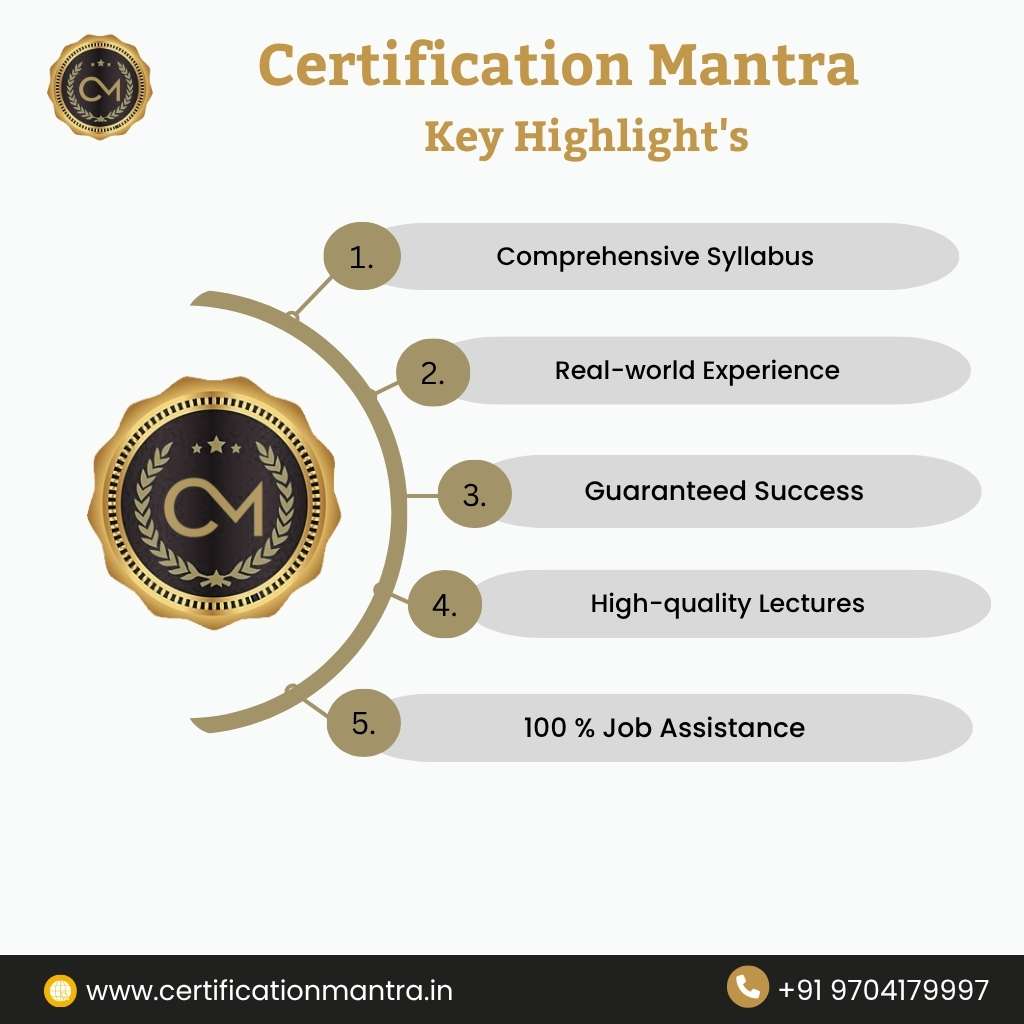
100% Pass Guarantee

We guarantee your success! With our unique methodologies and constant assessment

Crack in First Attempt

We don't cut any corners when it comes to providing you the best training.

Certified Trainers

All our trainers are certified and have a proven track record of providing high-quality training.

Certified Quality Auditor (CQA) Certification Training in Hyderabad
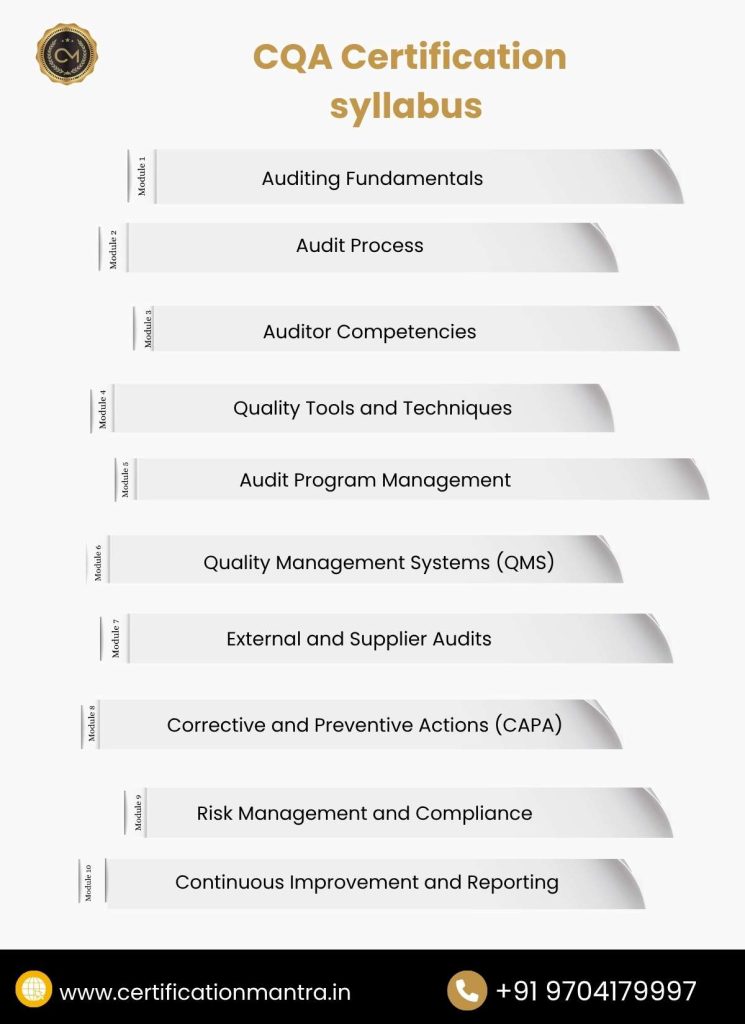
  •  Understand the purpose, principles, and process of quality auditing in modern organizations.
  • Learn the difference between compliance, system, and process audits.
  • Gain insight into audit objectives, ethics, and professional conduct for a Certified Quality Auditor (CQA).
  •  Master the step-by-step approach to planning, conducting, and reporting audits effectively.
  • Know how to prepare audit checklists, sampling methods, and documentation tools.
  • Learn risk-based auditing techniques to identify and prioritize key issues.
  •  Develop strong interviewing, communication, and observation skills for better audit outcomes.
  • Understand team dynamics, leadership, and conflict resolution during audits.
  • Recognize the importance of objectivity, integrity, and independence in auditing.
  •  Get familiar with basic and advanced quality tools like Pareto charts, cause-and-effect diagrams, and control charts.
  • Learn how to apply statistical methods in auditing and data interpretation.
  • Use problem-solving and improvement tools for process optimization.
  •  Discover how to develop, implement, and maintain audit programs.
  • Understand how to assign responsibilities, manage resources, and track performance.
  • Learn how to use audit metrics and KPIs for continuous improvement.
  •  Explore standards like ISO 9001, IATF 16949, ISO 13485, and AS9100.
  • Understand how a Certified Quality Auditor (CQA) ensures compliance with QMS requirements.
  • Learn how to audit documentation, corrective actions, and management reviews.
  •  Master the process of auditing suppliers and external partners for compliance and reliability.
  • Learn how to evaluate supplier performance, contracts, and risk assessments.
  • Understand third-party and second-party audit protocols for global quality standards.
  • Understand how to identify nonconformities and root causes effectively.
  • Learn to develop and verify corrective and preventive action plans.
  • Monitor CAPA implementation to ensure continuous improvement.
  •  Explore risk-based thinking, FMEA, and compliance auditing.
  • Understand how to assess and mitigate risks within quality systems.
  • Learn to ensure compliance with industry regulations and legal standards.
  •  Focus on data-driven decision-making and performance tracking.
  • Develop skills to write clear, actionable audit reports.
  • Understand how the Certified Quality Auditor (CQA) supports business excellence and quality growth.
Certified Quality Auditor (CQA) Certification Training in Hyderabad

What is Certified Quality Auditor (CQA) exam?

  • The Certified Quality Auditor (CQA) exam tests your expertise in auditing principles, quality tools, and system management.
  • It’s designed for professionals who ensure process compliance and continuous improvement in their organizations.
  • The exam consists of multiple-choice questions that evaluate both practical knowledge and analytical skills.
  • You’ll be tested on key areas like audit process, quality management systems, and risk assessment.
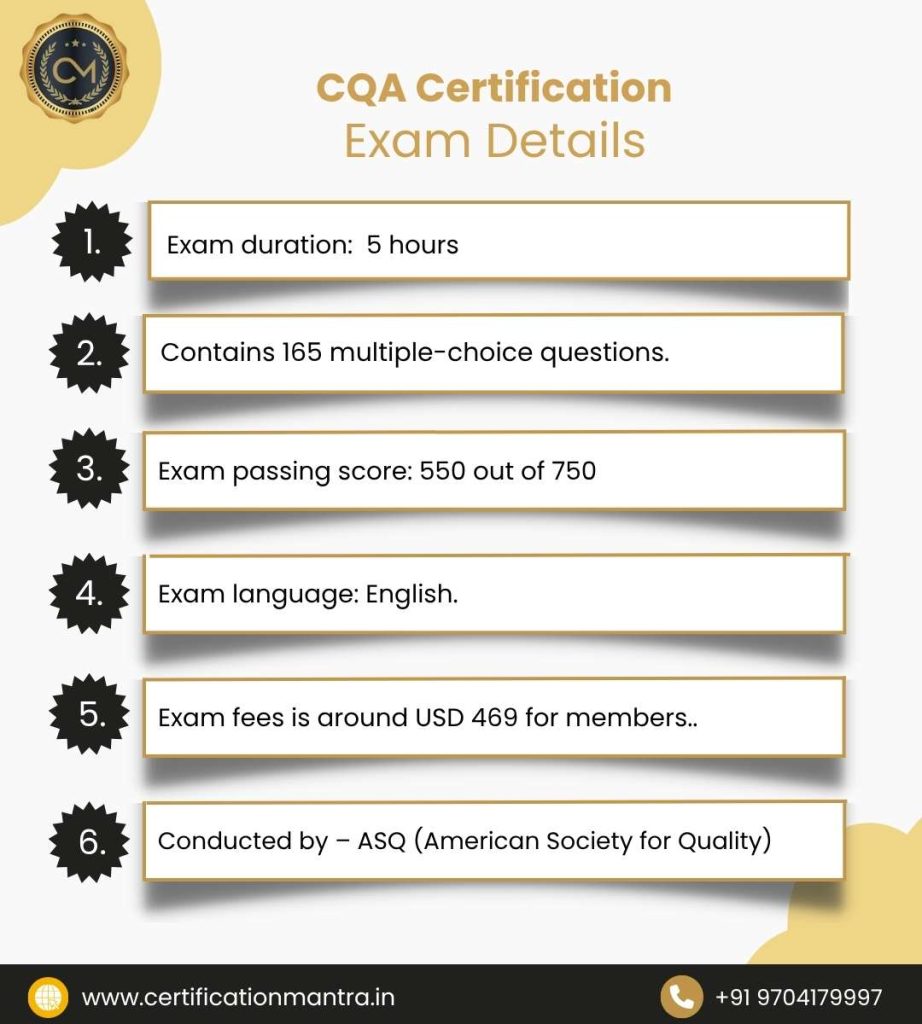
  • The CQA certification exam usually has 165 questions, with around 150 scored and 15 unscored (pretest) items.
  • You’ll get 5 hours to complete the exam, either online (remote proctored) or at an authorized test center.
  • The exam is open-book, meaning you can refer to approved reference materials during the test.
  • It’s important to have a strong understanding of ISO standards, audit planning, and CAPA systems before attempting it.
  • To pass, candidates must achieve a minimum scaled score of 550 out of 750.

Certified Quality Auditor (CQA) certification: Benefits

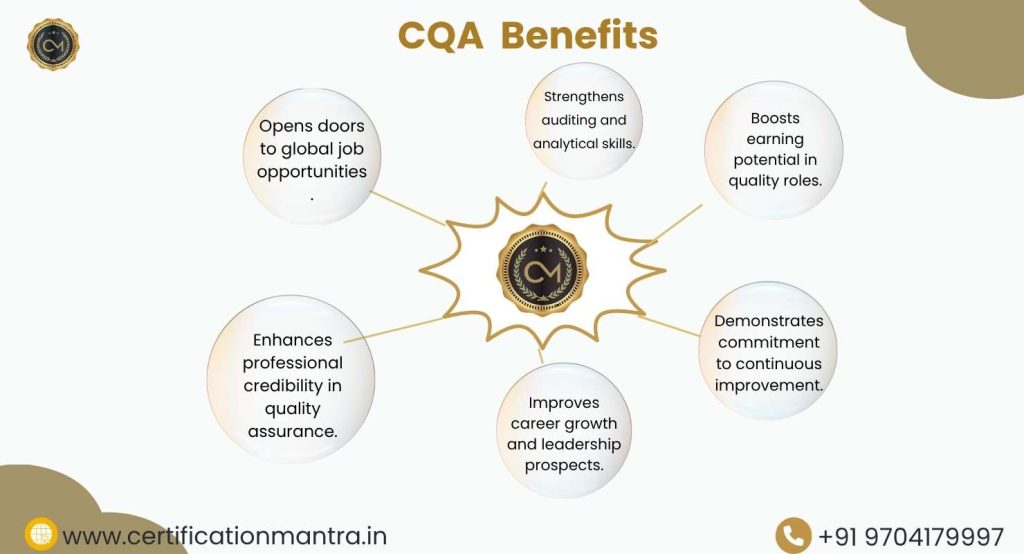
  • The Certified Quality Auditor (CQA) certification gives you a strong professional edge in the field of quality management and auditing.
  • It validates your ability to evaluate, analyze, and improve quality systems effectively across industries.
  • CQA-certified professionals are trusted for their expertise in auditing processes, compliance checks, and system improvements.
  • You’ll gain a deep understanding of ISO standards, quality tools, and risk-based thinking, boosting your confidence in real-world audits.
  • The certification opens doors to high-demand roles like Quality Auditor, Compliance Manager, and Quality Assurance Lead.
  • It enhances your credibility, showing employers your commitment to maintaining world-class quality standards.
  • The Certified Quality Auditor (CQA) credential can lead to higher salaries and faster career growth within the quality and manufacturing sectors.
  • You’ll also develop strong analytical and communication skills essential for conducting effective audits.
  • Global organizations recognize the CQA certification, making it an ideal choice for professionals aiming for international career opportunities.
  • Overall, this certification empowers you to drive continuous improvement and strengthen organizational performance.
Certified Quality Auditor (CQA) Certification Training in Hyderabad

Practical Training

Best Stimulations

Certified Quality Auditor (CQA) Certification Levels

There are three main levels in the CQA learning journey, helping professionals move from foundational quality concepts to advanced software quality management practices. These levels are explained as follows:

Foundational (Beginner Level)

The Foundational Level of Certified Quality Auditor (CQA) focuses on the core concepts of auditing and quality management systems. It introduces learners to audit principles, compliance standards, and documentation techniques. Ideal for beginners, this level builds a strong base to understand ISO standards.

Intermediate (Practitioner Level)

The Intermediate Level of Certified Quality Auditor (CQA) dives deeper into process auditing, corrective actions, and audit reporting. It helps professionals develop practical auditing skills, including planning and executing internal and supplier audits. Learners gain confidence in identifying non-conformities and improving system efficiency through structured audits.

Advanced (Expert Level)

The Advanced Level of Certified Quality Auditor (CQA) is designed for experienced professionals aiming to lead audit teams. It emphasizes strategic auditing, risk assessment, regulatory compliance, and continuous improvement leadership. Graduates of this level are equipped to manage complex audit programs and mentor other quality professionals globally.

SnowPro Core Recertification Certification Training in Hyderabad

Hands on Practice

Hands-on lab exercises with detailed answers.

Best Support

Support provided by our friendly support team

Real-life Case Studies

Realistic and relevant case studies that you can relate to your own projects.

Highly Qualified

Expert team of highly qualified faculty members.

Guidance from Experienced Instructors

Guidance throughout the entire course from highly experienced instructors who are there to help you at every step of the way.

Modes of Training

Online Training

Offline Training

Corporate Training

Certified Quality Auditor (CQA) Certification Course - Objectives

    • The Certified Quality Auditor (CQA) certification aims to develop professionals who can evaluate, analyze, and improve quality management systems effectively.
    • It focuses on building strong audit planning, execution, and reporting skills aligned with global quality standards.
    • The CQA program ensures candidates understand ISO standards, regulatory requirements, and compliance procedures.
    • It prepares professionals to identify non-conformities and suggest effective corrective and preventive actions.
    • The Certified Quality Auditor (CQA) enhances knowledge in risk-based auditing and performance evaluation methods.
    • It encourages a systematic approach to auditing, ensuring consistency and reliability in audit outcomes.
    • Learners gain expertise in process evaluation, supplier audits, and continual improvement.
    • The certification aims to develop leadership skills to manage audit teams and guide organizations toward excellence.
    • It promotes ethical auditing practices, emphasizing objectivity, integrity, and confidentiality.
    • Ultimately, the Certified Quality Auditor (CQA) helps professionals become trusted quality leaders in their organizations

Career Growth After the CQA Certification

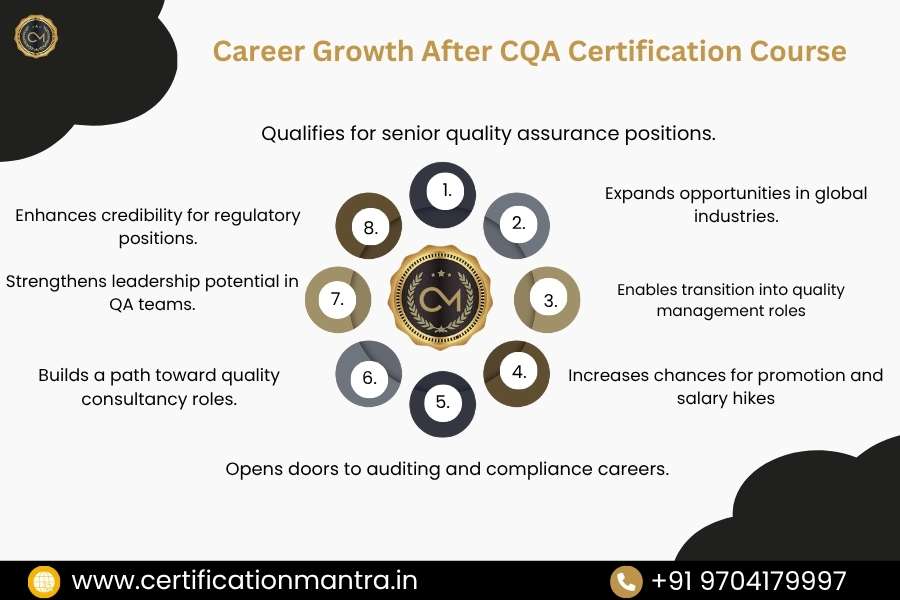
    • Earning the Certified Quality Auditor (CQA) certification opens doors to global career opportunities in manufacturing, pharmaceuticals, IT, and service industries.
    • Certified professionals are recognized as experts in quality systems, compliance, and auditing standards.
    • The certification boosts your credibility, helping you move into senior roles like Quality Manager, Lead Auditor, or Compliance Officer.
    • With Certified Quality Auditor (CQA) credentials, you can lead internal and external audits with confidence and authority.
    • Employers value CQAs for their ability to detect process gaps, enhance quality, and ensure regulatory compliance.
    • The certification also helps professionals transition into consultancy or training roles in the quality domain.
    • It’s a key stepping stone toward leadership positions in Quality Assurance and Process Excellence.
    • The Certified Quality Auditor (CQA) title demonstrates continuous learning and a commitment to quality improvement.
    • Many certified professionals experience salary growth and higher job security due to their specialized expertise.
Certified Quality Auditor (CQA) Certification Training in Hyderabad
    • To take the Certified Quality Auditor (CQA) exam, you should have a strong understanding of quality auditing principles and practices.
    • A minimum of eight years of professional experience is required, with at least three years in a decision-making role.
    • Relevant work experience can include areas like quality control, auditing, compliance, or regulatory management.
    • Those with a college degree or higher qualification may be eligible for reduced work experience requirements.
    • Candidates must be able to demonstrate knowledge of audit processes, risk assessment, and continuous improvement.
    • The Certified Quality Auditor (CQA) exam is ideal for professionals actively involved in internal or external auditing roles.
    • Applicants should also be familiar with international standards like ISO 9001, ISO 13485, or GMP guidelines.
    • It’s recommended that you complete a CQA training course or have practical exposure to quality audits before appearing.
    • Proficiency in document review, non-conformance reporting, and corrective action systems is beneficial.

Who Can Take CQA Certification?

  • The Certified Quality Auditor (CQA) exam is perfect for professionals who want to validate their expertise in auditing and quality management systems.
  • It’s ideal for quality auditors, engineers, managers, and compliance officers working across industries like manufacturing, pharma, healthcare, and IT.
  • Anyone responsible for conducting, managing, or improving audit processes can apply for the Certified Quality Auditor (CQA) certification.
  • Candidates with backgrounds in quality assurance, process improvement, or regulatory compliance will benefit the most.
  • Even if you’re new to auditing but have a passion for process excellence and risk-based thinking, this certification can open doors.
  • Professionals seeking career advancement, global recognition, or leadership roles in quality management should consider this certification.
  • The Certified Quality Auditor (CQA) exam welcomes both internal and external auditors, aiming to demonstrate their professional competence.
  • It’s also a great fit for consultants, suppliers, and auditors who evaluate systems for ISO, GMP, or industry-specific standards.
  • The program is suitable for both experienced professionals and those transitioning into the quality auditing field.
  • Overall, anyone eager to build authority, boost career credibility, and master auditing best practices can take the Certified Quality Auditor (CQA) exam.

How Can I Pass the CQA Certification Exam?

      • To pass the Certified Quality Auditor (CQA) exam, start by understanding the exam structure and key domains defined by ASQ.
      • Focus on the five main sections — Auditing Fundamentals, Audit Process, Auditor Competencies, Quality Tools, and Business Applications.
      • Create a realistic study plan that allows consistent daily review of each topic rather than last-minute cramming.
      • Use official ASQ study guides, CQA handbooks, and online mock tests to strengthen your conceptual and analytical skills.
      • Practice situational and scenario-based questions to improve your ability to apply audit principles in real-world cases.
      • Join CQA study groups or online forums to exchange notes, discuss tough topics, and stay motivated.
      • Familiarize yourself with audit case studies, quality standards (ISO 9001, ISO 19011), and best practices in auditing.
      • Manage your exam time wisely — aim to complete each question thoughtfully and leave time for review.
      • Stay calm and confident; the Certified Quality Auditor (CQA) exam tests your practical understanding, not just theory.

Certified Quality Auditor (CQA) Exam Pattern

Certified Quality Auditor (CQA) Certification Training in Hyderabad

Certified Quality Auditor (CQA) Certification Exam Cost?

  • The Certified Quality Auditor (CQA) exam cost varies depending on your ASQ membership status.
  • For ASQ members, the exam fee is generally lower, offering great value for professionals pursuing quality excellence.
  • Non-members usually pay a slightly higher fee, but they still gain access to a globally recognized certification.
  • The CQA exam fee covers application processing, testing, and access to official certification resources.
  • Additional costs may apply for rescheduling or retaking the exam, so proper planning is essential.
  • Candidates can also invest in ASQ study guides and CQA training courses to enhance their preparation.
  • Fees may vary slightly based on location, testing center, or online exam format.
  • The Certified Quality Auditor (CQA) certification is a worthy investment that can significantly boost your career prospects and salary potential.
  • Employers often reimburse exam costs as part of professional development initiatives — it’s worth checking!
  • Overall, the CQA exam is affordable, practical, and offers long-term professional returns in the field of quality auditing.

Certified Quality Auditor (CQA) Certification Exam Retake Policy

If you don’t pass the Certified Quality Auditor (CQA) exam on your first attempt, don’t worry — ASQ allows you to retake the exam. You can reapply by paying a retake fee, which is usually lower than the initial exam cost. This gives you another opportunity to strengthen your preparation and improve your performance.

Before retaking the CQA exam, it’s smart to review your weak areas, revisit key topics, and maybe enroll in a Certified Quality Auditor (CQA) training program. ASQ recommends waiting for the next available testing window to ensure you have enough time to prepare effectively. Retaking the exam helps you gain deeper insights into quality auditing practices and boosts your confidence for success.

CQA Certification Exam Cancellation Policy

If you’ve registered for the Certified Quality Auditor (CQA) exam but can’t make it, you can cancel your exam by logging into your ASQ account before the scheduled test date. ASQ allows cancellations within a specific period, usually up to 30 days before your exam window, to be eligible for a partial refund.

However, if you cancel the CQA exam after the deadline or fail to appear on exam day, your fee may be forfeited. It’s always a good idea to check ASQ’s official cancellation policy before applying. Planning ensures you don’t lose your exam fee and can reschedule your Certified Quality Auditor (CQA) exam at a more convenient time.

What Our Students Say'S

The Certified Quality Auditor (CQA) certification gave me a structured understanding of audit processes and compliance. It helped me conduct internal audits more efficiently and get recognized in my organization.
Ramesh K
I always wanted to grow in the quality field, and CQA made it possible. The training modules were clear, practical, and easy to apply at work. I highly recommend it to anyone aiming for a global quality credential.
Priya S
Preparing for the Certified Quality Auditor (CQA) exam was challenging but rewarding. The case studies and examples helped me connect theory with real-world applications. Passing this exam boosted my confidence a lot.
Arjun M
The CQA certification gave me the professional edge I needed to lead audit teams. I also gained a deeper understanding of regulatory standards and process improvement methods.
Sneha P
After earning the Certified Quality Auditor (CQA) credential, I noticed a huge improvement in how clients value my expertise. The course content is very detailed and aligns perfectly with industry expectations.
Vijay R
I loved how the CQA program focused on both technical and practical aspects of auditing. It made me more confident in leading quality checks and continuous improvement initiatives.
Meena T

Frequently Asked Questions

SnowPro Core Recertification Certification Training in Hyderabad
  •  The Certified Quality Auditor (CQA) certification validates your knowledge in auditing, process evaluation, and compliance management within quality systems.

  •  The CQA certification is offered by the American Society for Quality (ASQ), a globally recognized organization for quality professionals.

  •  Candidates need 8 years of work experience, with at least 3 years in a decision-making role related to quality auditing.

  • The CQA syllabus includes auditing principles, quality tools, process analysis, leadership, and standards like ISO 9001.

  •  The exam has 165 multiple-choice questions, out of which 150 are scored and 15 are unscored.

  •  The Certified Quality Auditor (CQA) exam duration is 5 hours and 18 minutes.

  •  ASQ does not publish exact passing scores, but typically, you need around 70% accuracy to pass.

  •  You can apply directly through the ASQ official website by creating an account and submitting your exam application.

  •  The CQA exam cost is around $498 for non-members and $348 for ASQ members.

  •  Yes, ASQ offers both computer-based and in-person testing options for flexibility.

  •  You can use the ASQ CQA Handbook, online practice tests, and auditor training modules for preparation.
  •  Most professionals take 2 to 4 months of focused study to prepare thoroughly.

  • Yes, relevant work experience is required to ensure candidates have practical knowledge of audit systems.

  •  No, freshers are not eligible as the CQA certification requires professional experience in quality management.

  •  The Certified Quality Auditor (CQA) certification is valid for 3 years.

  •  You can renew it by submitting recertification units (RUs) or retaking the exam.

  •  It enhances your career growth, salary potential, and positions you as a quality expert.

  •  Yes, the CQA certification is recognized internationally across industries.

  • Absolutely — many organizations prefer CQA-certified professionals for senior quality and audit roles.

  •  Industries like manufacturing, healthcare, pharma, automotive, and aerospace value this credential highly.

  •  Follow a structured study plan, use ASQ-recommended books, and practice mock tests regularly.

  •  Yes, ASQ allows candidates to retake the exam by paying the re-exam fee.

  •  No, there is no negative marking in the Certified Quality Auditor (CQA) exam.

  •  The exam is moderately difficult, requiring both conceptual clarity and practical audit experience.

  •  You’ll gain audit planning, data analysis, compliance review, and reporting skills.

  •  Yes, ASQ offers online and classroom training for Certified Quality Auditor (CQA) aspirants.

  •  The CQA exam is available year-round, depending on your test location or online slot availability.

  •  Yes, the CQA exam is open to candidates worldwide through ASQ’s global testing centers.

  • CQA professionals typically earn between ₹6 LPA to ₹18 LPA, depending on experience and industry.

  • Definitely! The CQA certification strengthens your credibility, opens new career paths, and increases professional value globally.

Enroll For the Free Demo Class

Get Certified With Certification Mantra