

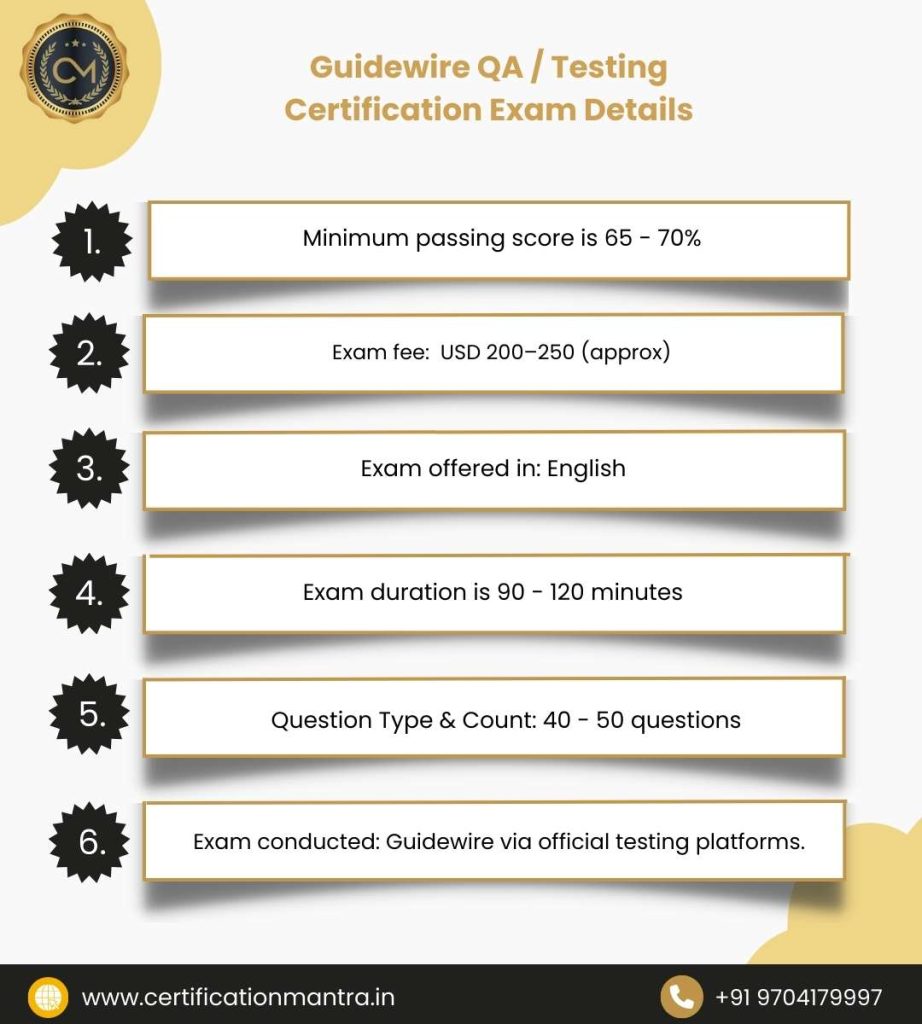
- Register through the official Guidewire certification portal.
- Choose the exam slot based on your convenience.
- Ensure a stable internet connection and valid ID for online exams.
- Review exam guidelines and rules before starting.
- Complete pre-exam system checks for online testing.
- Attempt scenario-based and multiple-choice questions.
- Use time wisely to answer all questions thoroughly.
- Submit the exam once all questions are completed.
- Receive results via the official Guidewire portal or email.
- Retake the exam if necessary, following the official retake policy.
Frequently Asked Questions

- It validates QA skills in Guidewire applications.
Focuses on testing insurance software workflows.
Recognized in insurance IT projects.
Yes, basic QA knowledge is sufficient.
Insurance concepts are taught gradually.
Ideal for entry-level QA professionals.
Yes, questions are scenario-based.
Focus is on practical testing situations.
Real project understanding is tested.
Coding is not mandatory.
Basic automation knowledge is helpful.
Manual testing concepts are key.
Policy handling workflows.
Billing and payment processes.
Claims lifecycle validations.
The exam is conducted online.
Remote proctoring may apply.
Stable internet is required.
Multiple-choice questions.
Scenario-based problem statements.
Concept validation questions.
Duration is usually 90 to 120 minutes.
Time depends on question count.
Time management is important.
Yes, it is recognized internationally.
Accepted by Guidewire partners.
Valuable for global projects.
Yes, freshers can apply.
Basic QA understanding is enough.
Training improves readiness.
Not mandatory.
Functional exposure is helpful.
Training bridges knowledge gaps.
Basic automation concepts may appear.
Focus remains on QA fundamentals.
Advanced scripting is not required.
Understand QA workflows clearly.
Practice scenario-based questions.
Revise insurance processes.
Yes, they improve confidence.
Help with time management.
Highlight weak areas.
Yes, retakes are allowed.
Each retake needs fresh payment.
Waiting rules may apply.
Yes, learning follows structured levels.
Foundation comes first.
Advanced skills build later.
Yes, it improves job visibility.
Adds credibility to QA profiles.
Supports promotions and role changes.
Basic concepts are covered.
Focus is on system behavior.
Advanced tools may be introduced.
Yes, digital certification is provided.
Available through official portal.
Can be shared on profiles.
Training is not mandatory.
But it improves success chances.
Helps understand exam structure.
Yes, insurance workflows are core.
QA depends on business logic.
Concept clarity is essential.
QA Analyst roles.
Functional Tester positions.
Insurance testing profiles.
Yes, IT professionals can transition.
Insurance domain exposure helps.
QA skills remain transferable.
Yes, test cases and reports matter.
Clear documentation is emphasized.
Helps in real projects.
Exams are available year-round.
Slots depend on availability.
Advance booking is recommended.
Usually no negative marking.
Accuracy is still important.
Read questions carefully.
Minor updates may occur.
Core QA concepts remain stable.
Check official guidelines before exam.
Yes, rescheduling may be allowed.
Rules depend on timing.
Fees may apply.
Yes, insurance IT demand is strong.
Guidewire skills are valued.
QA roles are consistently available.
Validity depends on Guidewire policy.
Some certifications require updates.
Staying current is recommended.