

Frequently Asked Questions

- SAP S/4HANA PP & Manufacturing is a module that manages end-to-end production operations. It helps companies plan, schedule, and execute manufacturing processes efficiently. The system uses real-time data to improve productivity and reduce delays.
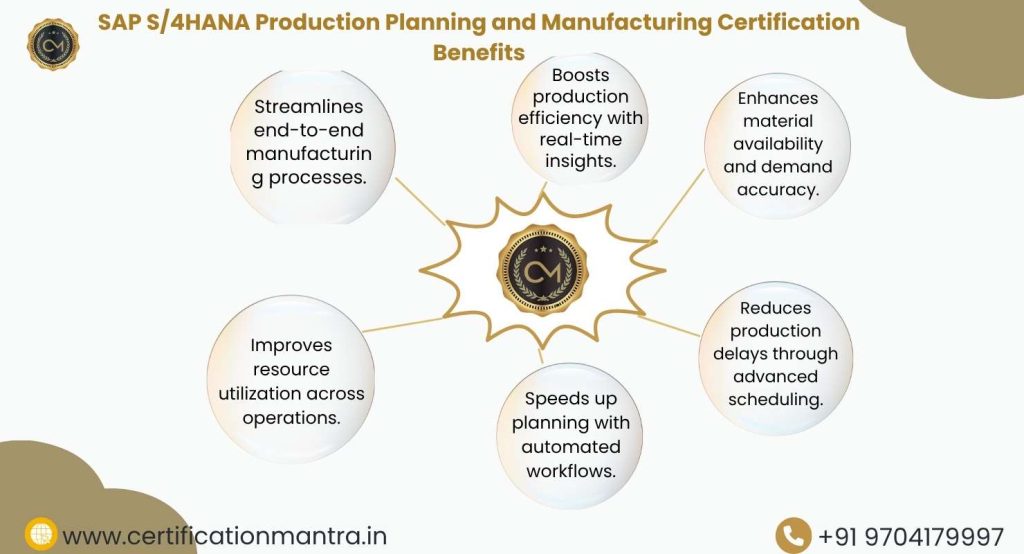
- It streamlines planning, production orders, MRP, and capacity management. The module improves operational accuracy through real-time insights. It also supports faster decision-making for manufacturing teams.
- Manufacturing professionals, planners, engineers, and SAP consultants benefit the most. Anyone entering the SAP functional domain can learn it. Freshers with supply chain or production knowledge can also start.
- Yes, freshers with basic supply chain or engineering knowledge can do well in this module. The concepts are logical and process-oriented. Proper training makes the certification easier to crack.
- A basic understanding of manufacturing processes is helpful. Familiarity with SAP navigation adds an advantage. Still, beginners can learn from scratch with guided training.
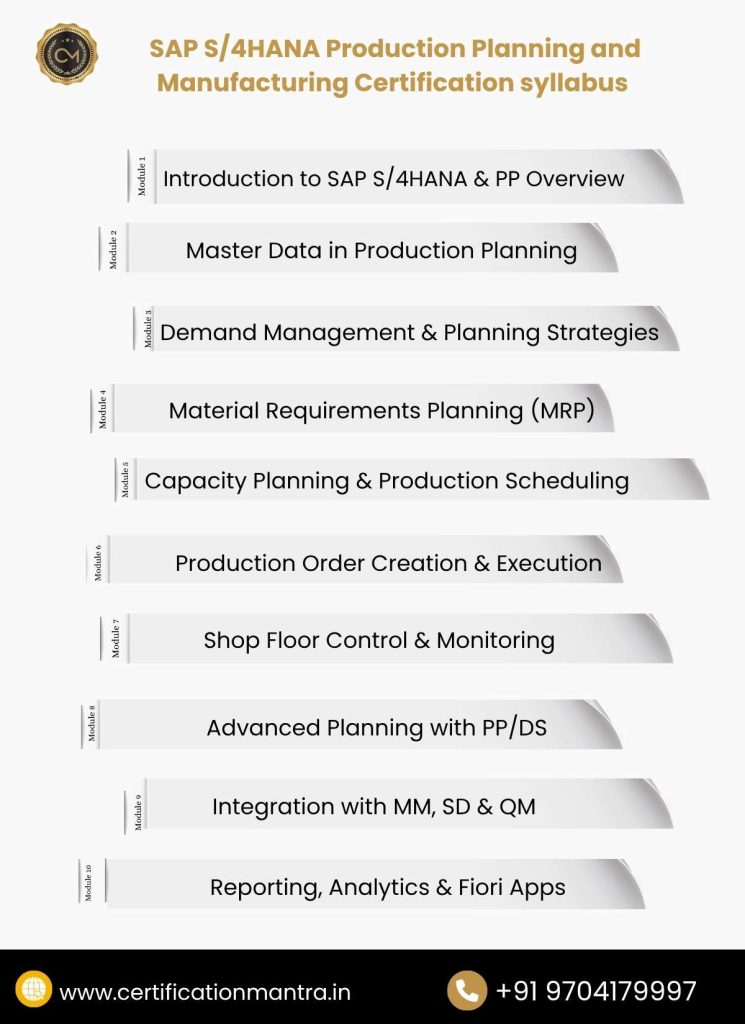
- The syllabus includes master data, MRP, planning, production orders, and shop floor control. It also covers PP/DS and analytics. Integration with MM, SD, and QM is part of the curriculum.
- MRP calculates material quantities and schedules procurement or production. In S/4HANA, it runs faster through MRP Live. It makes sure the required materials are ready exactly when they’re needed.
- PP/DS is Production Planning and Detailed Scheduling. It helps optimize sequencing, capacity, and constraint-based planning. It’s used for complex manufacturing environments.
- The module is detailed but not difficult with proper guidance. Concepts make sense when linked with real manufacturing scenarios. Hands-on practice simplifies learning.
- No, SAP PP is a functional module. You work more with processes and configurations than programming. Technical knowledge is optional.
- With regular training, it usually takes 6–8 weeks to learn. Practice on system exercises speeds up understanding. Certification preparation may take slightly longer.
- Yes, demand is high due to rapid S/4HANA migration worldwide. Companies want skilled PP consultants for transformation projects. Manufacturing-driven industries rely heavily on SAP PP expertise.
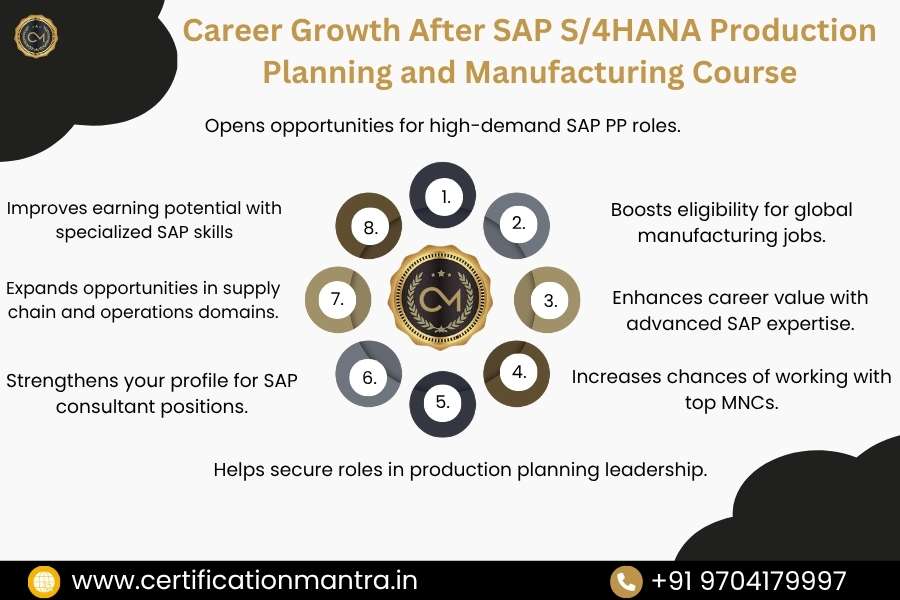
- You can work as an SAP PP Consultant, Planner, Analyst, or Manufacturing Specialist. Advanced learners can move toward PP/DS and Solution Architect roles. Opportunities exist in both IT and industry sectors.
- Manufacturing, automotive, pharma, FMCG, aerospace, engineering, and textiles. Any business with production processes needs PP consultants. Global SAP consulting firms also hire extensively.
- Yes, certification proves your understanding of SAP PP processes. It boosts job opportunities and salary potential. It also helps you qualify for global SAP consulting roles.
- Yes, shop floor control is a major component. It handles order confirmation, production execution, and monitoring. Real-time updates improve workflow accuracy.
- A production order instructs the plant to produce a material. It contains components, routing steps, and schedule details. Orders help track progress and consumption.
- Routing defines the sequence of operations needed to make a product. It lists work centers, resources, and time standards. It is essential for scheduling and cost calculation.
- A Bill of Materials (BOM) lists all components required to produce a finished product. It can be single-level or multi-level. BOM accuracy directly impacts planning.
- SAP does not mandate experience for certification. However, practical exposure helps understand scenarios better. Training fills the knowledge gap effectively.
- The exam usually includes around 80 questions. They cover configurations, processes, and S/4HANA innovations. Most questions are multiple-choice or scenario-based.
- The exam duration is typically 180 minutes. Time management is important as the questions are detailed. You can take it online from anywhere.
- The required passing score is determined by SAP’s global standards. It usually ranges around the standard SAP passing percentage. The official site displays the exact number.
- Yes, SAP allows retakes as part of the certification subscription. You get multiple attempts for the same exam version. Prepare well before attempting again.
- Yes, certification adds credibility to your technical profile. It shows employers you have verified SAP expertise. Many professionals receive faster growth after certification.
- Absolutely, mechanical and production engineers adapt very well to SAP PP. The concepts align naturally with their domain knowledge. Many engineers transition into SAP consulting roles.
- Yes, SAP PP integrates tightly with MM, SD, QM, and FI/CO. This ensures smooth material movement and production flow. Integration knowledge increases your value as a consultant.
- You use Fiori apps, analytical dashboards, and PP/DS tools. Traditional SAP GUI functions are also available. S/4HANA adds real-time insights for better decision-making.
- The future is strong due to global S/4HANA adoption and Industry 4.0 transformation. Companies need experts who understand digital manufacturing. PP/DS, automation, and AI skills further boost growth.
- Training gives you structured learning, hands-on practice, and real examples. It simplifies complex topics like MRP, planning, and production orders. It also prepares you confidently for the certification exam.