

Frequently Asked Questions

- SAP SuccessFactors Employee Central is a cloud-based HR management platform that handles core employee data. It supports hiring, transfers, promotions, and exits with automation. It helps organisations manage HR processes efficiently across global locations.
- Employee Central is one of the most in-demand SAP HR modules today. It offers strong career opportunities in HR tech and cloud consulting. Learning it helps you work on global HR transformation projects.
- Yes, EC is beginner-friendly and easy to learn with proper guidance. Even HR professionals with no technical background can master it. A structured training program makes the learning journey smooth.
- It includes employee data management, workflows, business rules, and organisational structures. It supports global HR policies with localisation.“It connects smoothly with other SAP modules, ensuring effortless and unified system integration.
- EC is used across healthcare, IT, manufacturing, retail, energy, and banking. Companies rely on it for consistent HR operations worldwide. Its scalability makes it suitable for both small and large enterprises.
- No, technical expertise is not mandatory for EC. HR and management knowledge is enough to get started. Technical consultants can also learn it easily with basic HR awareness.
- You need basic HR process knowledge and comfort working with digital tools. Understanding workflows and employee data helps a lot. Curiosity and willingness to practice daily are key.
- Yes, EC is one of the top-paying SAP HR roles. The demand for certified EC consultants continues to grow worldwide. It offers long-term career stability in the cloud HR space.
- With focused training, most learners understand EC basics in 4–6 weeks. Advanced concepts may take additional practice. Consistent hands-on learning accelerates your progress.
- Yes, EC supports localization for multiple countries. It includes legal rules, formats, and statutory fields required globally. This helps organizations maintain compliance effortlessly.
- Position Management helps define roles and reporting structures in the organization. It keeps position and employee data synced automatically. It enables efficient workforce planning.
- RBP controls who can access which HR data in the system. It ensures data security by assigning permissions based on roles. It helps organizations protect sensitive employee information.
- Foundation Objects form the structure of an organisation, such as departments, divisions, and locations. They define how HR data is arranged. Configuring them properly ensures accurate HR operations.
- Certification strengthens your profile and increases job opportunities. It validates your knowledge of EC configurations and workflows. Employers prefer certified SAP consultants for implementation roles.
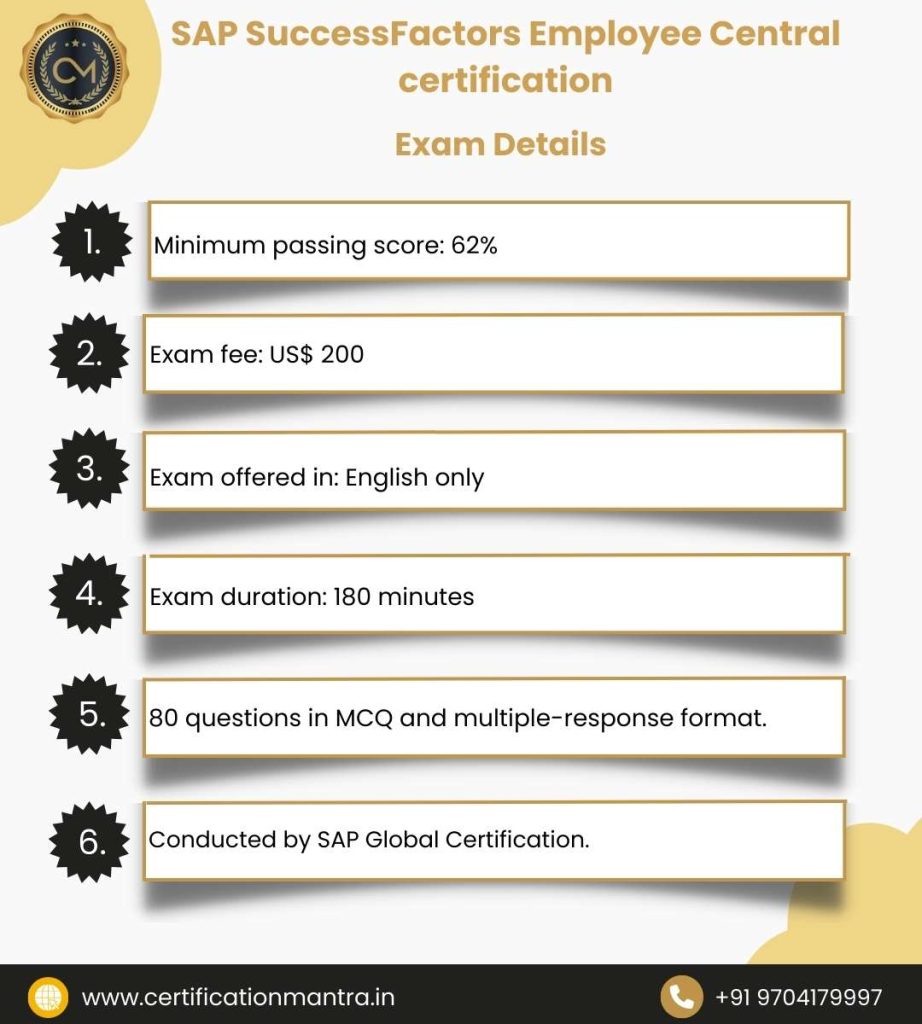
- The exam is moderate if you prepare well. It tests your understanding of configurations, rules, and data models. Practice and revision greatly improve your chances of passing.
- Yes, the certification exam is conducted online through SAP’s Certification Hub. You can take it from home or the office with a proctored setup. A stable internet connection is required.
- The exam mostly includes multiple-choice and scenario-based questions. It tests practical understanding rather than memorisation. Hands-on practice makes answering easier.
- The passing score varies depending on the exam code. SAP usually sets it between 60% and 70%. Checking the official exam guide gives exact details.
- Yes, many HR professionals transition into SAP SuccessFactors roles successfully. Their HR knowledge gives them a strong advantage. With proper training, the shift becomes easier.
- You can work as an EC Consultant, HRIS Analyst, Implementation Consultant, or Support Specialist. There are also opportunities in payroll and integration teams. Certified professionals enjoy high market demand.
- No, EC works for small, medium, and large companies. Its cloud setup makes it flexible for businesses of all sizes. It scales easily with workforce growth.
- Yes, it includes tools like Story Reports, Dashboards, and Canvas. These help HR teams generate insights and monitor workforce trends. Reporting is user-friendly and customizable.
- MDF (Metadata Framework) helps create custom objects and fields in EC. It extends system capabilities without coding. It allows organisations to adapt EC to their unique needs.
- Yes, it integrates with SAP Payroll, EC Payroll, and third-party payroll systems. Data flows smoothly using APIs and integration tools. This ensures accurate salary processing.
- EC automates repetitive HR tasks with workflows and rules. It reduces manual work and errors. It allows HR teams to focus on strategic activities.
- Yes, SAP follows strict global security standards. RBP, audit logs, and encryption protect data at every level. It ensures compliance with privacy laws.
- The demand for cloud HR systems is growing rapidly. EC continues to evolve with new features and AI-driven tools. It promises strong job opportunities for the long term.
- Yes, freshers can start learning EC with basic HR understanding. Many companies hire fresh consultants with certification. Proper training helps build a strong foundation.
- No, coding is not required for EC configuration. Most tasks involve settings, rules, and templates. Technical developers are only needed for integration work.
- Start with a structured training program that covers real-time scenarios. Practice regularly on system exercises to build confidence. Certification boosts your profile and career opportunities.