
AWS Data Engineer Certification Course in Hyderabad (DEA-C01)
AWS Data Engineer Certification Course in Hyderabad at Certification Mantra is designed for people who want to learn how data engineering actually works on AWS. Over 40 hours of instructor-led training, you’ll explore how to collect data, clean it, build pipelines, choose the right storage services, and keep everything running securely.
The course includes practical exercises with Amazon S3, AWS Glue, Redshift, Athena, Kinesis, Lambda, and other AWS services. You’ll also work through projects and prepare for the AWS Certified Data Engineer – Associate (DEA-C01) exam.
- Course Duration: 40 Hours
- Training Fee: ₹24,999
- Training Modes: Classroom and Live Online
- Certification: AWS Certified Data Engineer – Associate
- Exam Code: DEA-C01
- Official AWS Exam Fee: Separate
What Is the AWS Data Engineer Certification Course in Hyderabad?
The AWS Data Engineer Course in Hyderabad at Certification Mantra covers data ingestion, ETL pipelines, cloud storage, data transformation, and pipeline monitoring using AWS services. The 40-hour training includes hands-on labs, practical projects, and preparation for the AWS Certified Data Engineer – Associate (DEA-C01) exam.
AWS Data Engineer Course at a Glance
| Course Detail | Information |
|---|---|
| Course | AWS Data Engineer Certification Course in Hyderabad |
| Institute | Certification Mantra |
| Duration | 40 Hours |
| Training Fee | ₹24,999 |
| Training Options | Classroom and Live Online |
| Location | Near JNTU, Hyderabad |
| Certification Preparation | AWS Certified Data Engineer – Associate |
| Exam Code | DEA-C01 |
| Certification Level | Associate |
| Curriculum | 16 Modules |
| Practical Labs | 12 Listed Labs |
| Projects | 4 Listed Projects |
| Exam Preparation | Included |
| AWS Exam Fee | Separate |
| Next Batch | Contact us for the latest schedule |
Please note: Certification Mantra provides training and exam-preparation guidance. The official AWS certification is awarded by Amazon Web Services after you pass the DEA-C01 exam.
Why Learn AWS Data Engineering?
Think about what happens when someone orders a product online.
The website records the order, payment information, delivery details, and customer activity. Thousands of similar records may be generated every day.
A business needs this information to understand sales, track orders, prepare reports, and make decisions. But before that can happen, the data must be collected, checked, organized, and stored properly.
That’s the work of a data engineer.
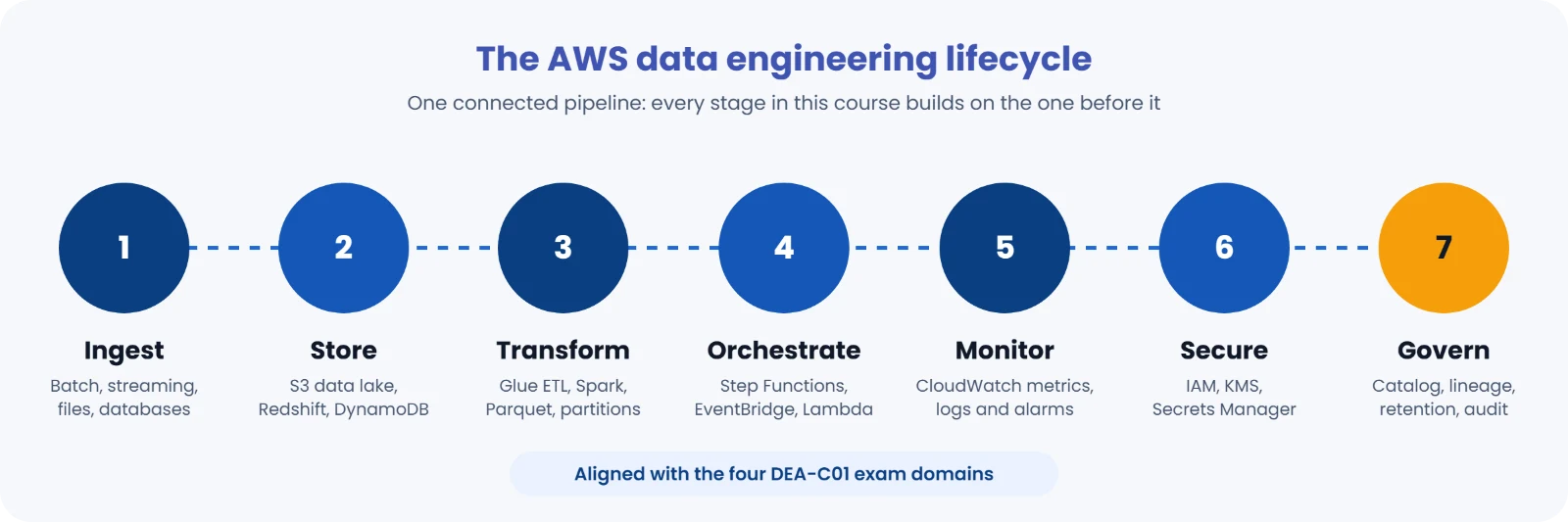
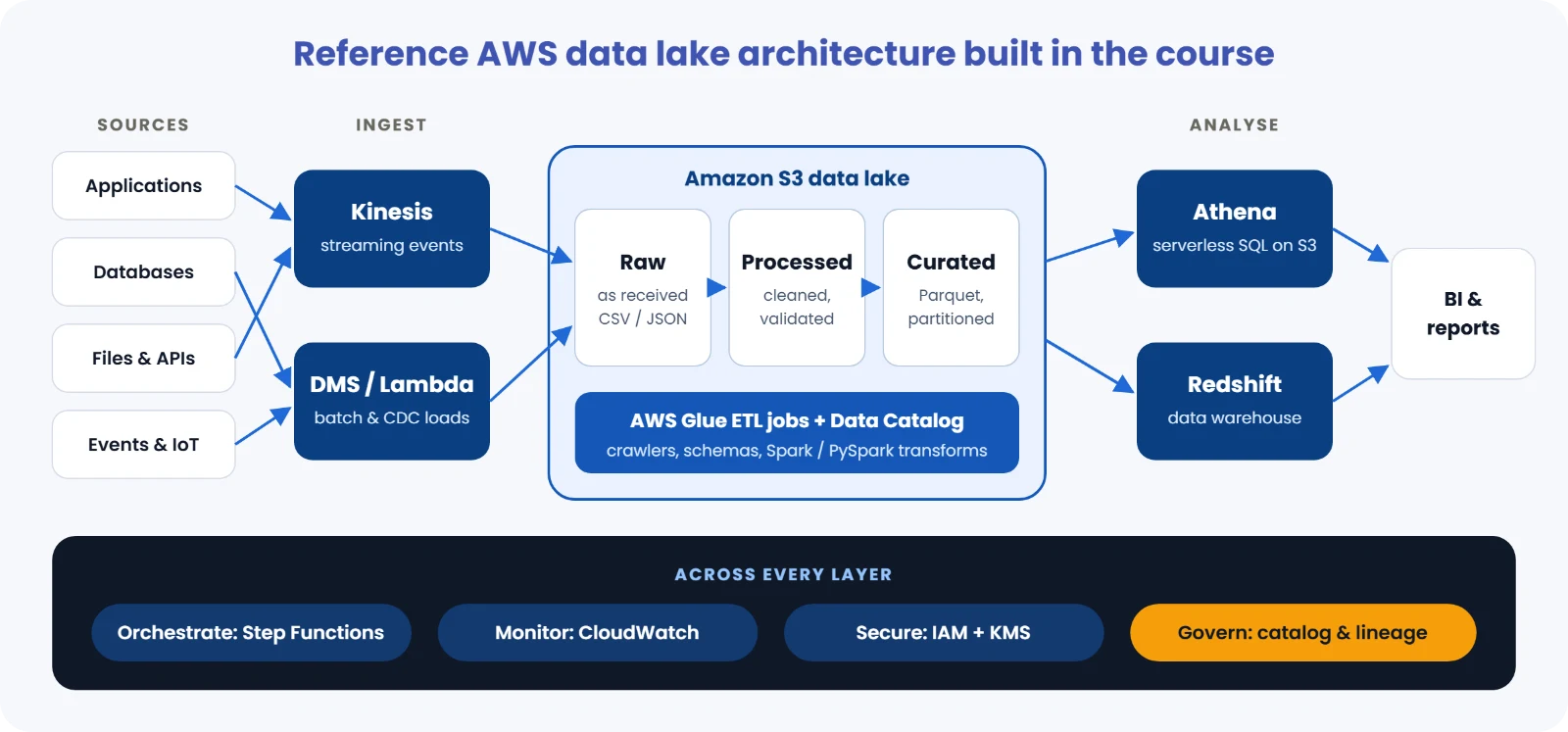
On AWS, different services handle different parts of this process. Amazon S3 can store large amounts of data. AWS Glue can help clean and transform it. Amazon Redshift and Athena can make that data available for analysis.
Learning AWS data engineering means understanding how to connect these services into a reliable system.
You’ll learn how to answer everyday technical questions, such as which service to choose, how to deal with a failed processing job, and how to avoid unnecessary storage or processing costs.
What Will You Learn in This AWS Data Engineer Course?
The course starts with the basics and gradually moves into the work involved in building and managing data pipelines.
You’ll learn how to:
- Collect data from files, databases, applications, and streaming sources.
- Build data ingestion and transformation workflows.
- Create ETL pipelines using AWS Glue.
- Organize datasets in Amazon S3.
- Use SQL to prepare and query data.
- Work with Amazon Redshift for data warehousing.
- Query files directly using Amazon Athena.
- Understand Spark and PySpark processing.
- Handle streaming data with Amazon Kinesis.
- Automate processing with Lambda and Step Functions.
- Monitor AWS data jobs using CloudWatch.
- Identify and troubleshoot common pipeline failures.
- Apply IAM permissions and encryption.
- Check data quality and manage retention.
- Improve data processing performance and cost efficiency.
- Prepare for questions based on real AWS scenarios in the DEA-C01 exam.
The aim is to help you understand not only how a service works, but also when and why you would use it.
AWS Data Engineering Training in Hyderabad: Learning Options
Classroom AWS Data Engineer Training
If you prefer attending classes in person, Certification Mantra offers classroom training near JNTU in Hyderabad.
Classroom sessions give you an opportunity to follow instructor demonstrations, discuss technical questions, and work through course exercises in a structured environment.
This option may suit learners who prefer direct interaction during training.
Live Online AWS Data Engineering Training
If travelling to a training centre is difficult, you can choose live online sessions.
The online course covers the AWS data engineering subjects and DEA-C01 preparation topics included in the program.
You can follow the lessons remotely and work through the practical exercises using the required AWS environment.
Which Training Option Should You Choose?
Choose the learning format that works with your schedule and study preferences.
Before enrolling, speak with the Certification Mantra team to confirm the next batch, class timings, lab access, and current training arrangements.
Who Should Join the AWS Data Engineer Certification Course?
You don’t have to be working as a Data Engineer already to start learning these skills.
The course is relevant to people with different technical backgrounds, including:
- Data Engineers who want to work with AWS cloud services.
- ETL Developers who want to build cloud-based data pipelines.
- SQL Developers looking to move beyond traditional databases.
- Database Administrators interested in AWS data platforms.
- Data Analysts planning to learn data engineering.
- Software Developers working with databases and data-driven applications.
- Cloud Engineers who want to understand data processing workloads.
- IT professionals preparing for the DEA-C01 certification.
If you’re new to data engineering, start by building your understanding of databases, SQL, and basic AWS concepts.
AWS describes the ideal DEA-C01 certification candidate as someone with relevant professional experience. Beginners can learn the subject, but they may need more practice before attempting the official exam.
Prerequisites for AWS Data Engineer Training
You don’t need advanced knowledge of every AWS service before joining.
It helps if you already understand a few basic concepts:
- How databases store information.
- Simple SQL queries.
- Tables, rows, columns, and data types.
- Basic programming logic.
- Cloud computing fundamentals.
- How data moves between applications and databases.
Knowing some Python can make the practical exercises easier, especially when working with transformations or Spark-based processing.
If these topics are new to you, spending time on the fundamentals will help you follow the course more comfortably.
AWS Services and Technologies Covered
AWS offers many services, and it can be confusing to understand which one belongs where.
During the course, you’ll learn them in the context of real data engineering tasks.
| Area | Services and Technologies |
|---|---|
| Data Storage | Amazon S3, Amazon RDS, Amazon DynamoDB |
| Data Integration | AWS Glue, Glue Data Catalog, Glue Crawlers |
| Data Warehousing | Amazon Redshift |
| SQL Analytics | Amazon Athena |
| Streaming Data | Amazon Kinesis |
| Large-Scale Processing | Amazon EMR, Apache Spark, PySpark |
| Serverless Processing | AWS Lambda |
| Workflow Automation | AWS Step Functions, Amazon EventBridge |
| Monitoring | Amazon CloudWatch, AWS CloudTrail |
| Security | AWS IAM, AWS KMS, AWS Secrets Manager |
| Programming and Data Formats | SQL, Python, CSV, JSON, Parquet |
For example, if you need to store incoming files, Amazon S3 may be suitable. If you need to transform those files, AWS Glue may help. If you want to run analytical SQL queries, Athena or Redshift may be appropriate depending on the requirements.
Learning to make those decisions is an important part of AWS data engineering.
AWS Data Engineer Certification Course Syllabus
The AWS Data Engineer course contains 16 modules covering foundational knowledge and the technical areas tested in DEA-C01.
The curriculum follows the four official AWS exam domains, with additional practical exercises to make the concepts easier to apply.
Module 1: AWS and Data Engineering Fundamentals
Every data pipeline starts with a clear understanding of the data being handled and the result the business needs.
This module introduces the role of a data engineer and the basic parts of a cloud data platform.
Topics covered:
- What data engineers do.
- Batch and streaming processing.
- Structured and unstructured data.
- ETL and ELT.
- Data lakes and data warehouses.
- AWS Regions and Availability Zones.
- Core AWS data services.
- Introduction to AWS IAM.
Hands-on activity: Explore an AWS environment, configure basic access, and examine how data can move from a source into cloud storage.
Domain 1: Data Ingestion and Transformation
Module 2: Data Ingestion Architecture
Before data can be analyzed, it needs to reach the right system.
Sometimes data arrives as a daily file. In other situations, new records arrive every second. Each situation needs a different approach.
You’ll learn how batch, streaming, and event-driven ingestion work, along with the challenges involved in moving data reliably.
Topics covered:
- Batch and streaming ingestion.
- File and database sources.
- Event-based data collection.
- Throughput and latency.
- Data validation.
- Failed-record handling.
- Reprocessing strategies.
- Choosing ingestion services.
Practical activity: Design an ingestion workflow that moves source data into AWS storage.
Module 3: Building Data Lakes with Amazon S3
Amazon S3 is commonly used as the starting point for AWS data lakes.
In this module, you’ll learn how to arrange data so that it can be stored, processed, and retrieved without creating unnecessary confusion.
Topics covered:
- S3 buckets and objects.
- Organizing data into logical layers.
- Storage classes.
- Versioning and lifecycle rules.
- Data partitioning.
- CSV, JSON, and Parquet formats.
- Encryption and access permissions.
- Storage cost considerations.
Practical activity: Create raw, processed, and curated data areas in Amazon S3.
Module 4: AWS Glue and ETL Development
Imagine receiving files from several departments. Each file might have different column names, missing values, or inconsistent formats.
AWS Glue helps you discover and transform this information before it is used elsewhere.
Topics covered:
- AWS Glue fundamentals.
- Glue Crawlers.
- Glue Data Catalog.
- ETL jobs.
- Job parameters and transformations.
- Schema changes.
- Scheduling.
- Monitoring and error handling.
Practical activity: Use AWS Glue to clean a sample dataset and save the transformed output.
Module 5: Spark and PySpark for Data Transformation
When datasets become too large for simple processing methods, distributed computing becomes useful.
This module introduces Spark and PySpark, with an emphasis on the data transformation tasks commonly found in engineering workflows.
Topics covered:
- Apache Spark basics.
- Spark DataFrames.
- Reading and writing data.
- Filtering and grouping.
- Joins and aggregations.
- Missing-value handling.
- Partitioning.
- PySpark transformations.
- Processing performance.
Practical activity: Perform transformations on sample data using Spark-based processing.
Module 6: Real-Time Processing with Amazon Kinesis
Not every business can wait until the following day to process new data.
Applications may need to respond to events as they happen, such as customer activity, sensor readings, or application logs.
In this module, you’ll see how streaming data is handled on AWS.
Topics covered:
- Streaming architecture.
- Data producers and consumers.
- Amazon Kinesis Data Streams.
- Shards and partition keys.
- Throughput.
- Scaling.
- Delivery and failure handling.
- Lambda integration.
- Stream monitoring.
Practical activity: Create a basic streaming workflow and process incoming records.
Domain 2: Data Store Management
Module 7: AWS Data Storage Architecture
Choosing the right database or storage service depends on how the information will be used.
A service that works well for application transactions may not be the best option for running large analytical queries.
This module helps you understand those differences.
Topics covered:
- Data storage requirements.
- Transactional and analytical workloads.
- Structured and semi-structured information.
- Amazon S3.
- Amazon RDS.
- Amazon DynamoDB.
- Data modeling.
- Availability and performance.
- Storage costs.
Practical activity: Compare storage options for an application database and an analytics system.
Module 8: Amazon Redshift Data Warehousing
Amazon Redshift is designed for analytical workloads where large volumes of data need to be queried.
You’ll learn how data is loaded, organized, and queried in a warehouse environment.
Topics covered:
- Redshift fundamentals.
- Warehouse architecture.
- Data loading.
- Table design.
- Distribution and sort strategies.
- Analytical SQL.
- Redshift Spectrum.
- Query performance.
- Security and monitoring.
Practical activity: Load sample business data into Redshift and run analytical queries.
Module 9: Amazon Athena and Serverless Analytics
Sometimes you need to analyze files stored in Amazon S3 without first loading them into a separate data warehouse.
Amazon Athena makes that possible using SQL.
This module explains how Athena works and how file organization affects query performance and cost.
Topics covered:
- Athena fundamentals.
- Glue Data Catalog integration.
- Creating tables.
- Querying CSV and Parquet.
- Partitioning.
- Query optimization.
- Managing query costs.
- Troubleshooting errors.
Practical activity: Query a partitioned dataset stored in Amazon S3.
Module 10: Data Lifecycle and Storage Optimization
Businesses cannot keep every piece of data in the same storage class forever.
Some information is used daily. Other records may only be needed for audits or historical reporting.
This module explains how data can be managed throughout its lifecycle.
Topics covered:
- Data retention.
- Archiving.
- S3 lifecycle policies.
- Backup and recovery.
- Replication.
- Schema changes.
- Storage optimization.
- Cost-aware data management.
Practical activity: Create a lifecycle plan for active and historical datasets.
Domain 3: Data Operations and Support
Module 11: Data Pipeline Orchestration
A data pipeline often involves several steps.
A file might need to be uploaded, validated, transformed, and stored before the final report can be generated.
Those steps should happen in the correct order, with a way to handle failures.
Topics covered:
- Workflow dependencies.
- Scheduled processing.
- Event-driven processing.
- AWS Step Functions.
- Amazon EventBridge.
- AWS Lambda.
- Retry logic.
- Failure recovery.
- Idempotent processing.
Practical activity: Connect ingestion, transformation, validation, and storage tasks into a coordinated workflow.
Module 12: Monitoring and Troubleshooting AWS Data Pipelines
A pipeline that worked yesterday can fail today because of changed source data, missing permissions, or service configuration issues.
Data engineers need to identify these problems and understand how to investigate them.
Topics covered:
- CloudWatch logs and metrics.
- CloudWatch alarms.
- AWS CloudTrail.
- Monitoring AWS Glue jobs.
- Redshift monitoring.
- Pipeline error analysis.
- Access-denied errors.
- Processing failures.
- Operational alerts.
Practical activity: Investigate a failed data-processing job and identify the reason behind the failure.
Module 13: Data Quality and Validation
Getting data into the system is only part of the job.
You also need to know whether the information is complete, correctly formatted, and suitable for use.
A pipeline can finish successfully while still producing incorrect results.
Topics covered:
- Data completeness.
- Data validity.
- Duplicate detection.
- Missing values.
- Schema validation.
- Consistency checks.
- Data-quality rules.
- Error handling.
- Reprocessing incorrect records.
Practical activity: Build checks to identify invalid records before sending data to an analytics system.
Module 14: Performance and Cost Optimization
Cloud services provide flexibility, but poor design choices can increase costs or slow down processing.
This module shows how decisions about storage formats, file sizes, partitioning, and service configuration affect a data workload.
Topics covered:
- Partitioning strategies.
- File formats.
- Compression.
- Query performance.
- Glue job efficiency.
- Redshift optimization.
- Storage cost management.
- Monitoring resource usage.
Practical activity: Compare different ways of organizing and querying a dataset.
Domain 4: Data Security and Governance
Module 15: AWS Data Security
Business data may include financial records, internal reports, or customer information. Not everyone should have access to everything.
This module explains how AWS security controls help protect data and restrict access.
Topics covered:
- IAM users and roles.
- IAM policies.
- Least-privilege access.
- Resource-based permissions.
- Encryption at rest.
- Encryption in transit.
- AWS KMS.
- AWS Secrets Manager.
- Access auditing.
Practical activity: Configure permissions and encryption for an example data pipeline.
Module 16: Data Governance and Compliance
As an organization collects more information, it becomes important to know where that information came from, who owns it, and who is allowed to use it.
This module introduces the governance concepts that support responsible data management.
Topics covered:
- Metadata.
- Data catalogs.
- Data ownership.
- Data classification.
- Data lineage.
- Access policies.
- Data retention.
- Audit requirements.
- Sensitive-data handling.
Practical activity: Prepare a simple governance plan for an AWS data platform shared by multiple teams.
Hands-On Labs in AWS Data Engineering Training
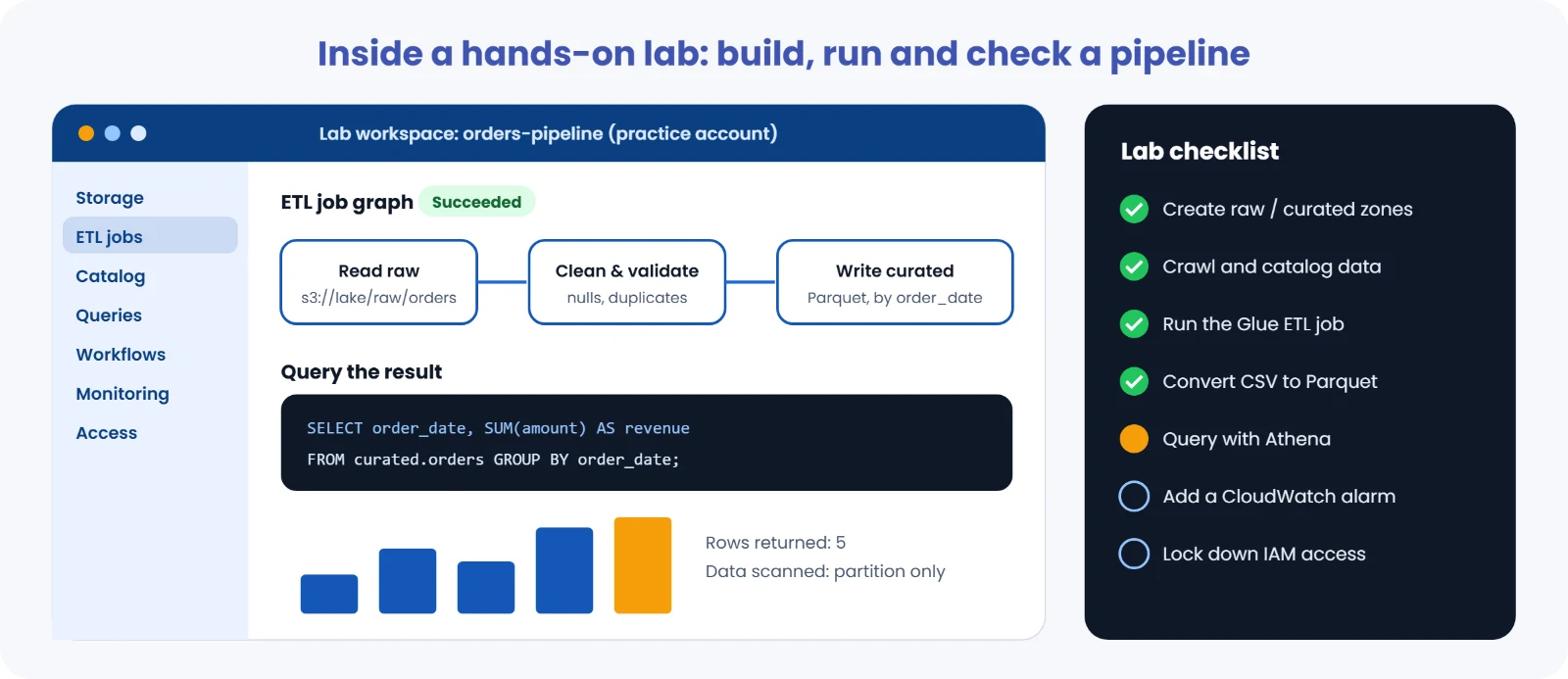
Reading about an AWS service helps you understand what it does. Working with the service helps you understand what happens when the configuration, data, or requirements change.
The course outlines the following 12 lab activities:
Lab 1
Create a data lake using Amazon S3
Lab 2
Discover datasets with AWS Glue Crawlers
Lab 3
Build an AWS Glue ETL job
Lab 4
Convert CSV records into Parquet
Lab 5
Query stored data using Amazon Athena
Lab 6
Load processed data into Amazon Redshift
Lab 7
Build a Kinesis streaming workflow
Lab 8
Process events using AWS Lambda
Lab 9
Orchestrate a multi-step workflow
Lab 10
Monitor a pipeline with Amazon CloudWatch
Lab 11
Configure IAM access permissions
Lab 12
Troubleshoot a failed data workflow
The exercises cover different stages of a data pipeline, from receiving information to processing, querying, monitoring, and securing it.
Real-World AWS Data Engineering Projects
Individual exercises are useful for learning AWS services. Projects bring those services together.
The four projects below give you examples of how AWS data engineering concepts can be applied to business situations.
Project 1: E-Commerce Sales Data Pipeline
An online business receives order information throughout the day. Its reporting team needs reliable sales data to identify revenue trends and popular products.
In this project, you’ll work with sample transaction records and build a batch-processing workflow.
The process involves storing raw files in Amazon S3, using AWS Glue to discover and transform the data, and preparing the output for analysis in Athena or Redshift.
What you’ll practice: S3, AWS Glue, SQL, data transformation, and analytical storage.
Project 2: Real-Time Application Event Processing
Imagine an application generating a continuous stream of user activity events.
Instead of waiting for a large batch file, the system needs to collect and process those events as they arrive.
You’ll explore an event-processing workflow using Amazon Kinesis, processing logic, storage, and monitoring.
What you’ll practice: Streaming ingestion, event processing, Kinesis, data delivery, and monitoring.
Project 3: Serverless Data Processing Workflow
A company receives new files at unpredictable times and wants processing to start automatically whenever a file arrives.
This project demonstrates how Amazon S3, AWS Lambda, Step Functions, and CloudWatch can work together in an automated workflow.
What you’ll practice: Event triggers, workflow orchestration, serverless processing, and troubleshooting.
Project 4: Secure Enterprise Data Lake
An organization stores information used by its finance, operations, and reporting teams.
Each team needs access to different data, so the system requires suitable permissions and security controls.
In this project, you’ll work with a data-lake structure that includes storage layers, IAM permissions, encryption, retention rules, and monitoring.
What you’ll practice: Data lake design, security, governance, and access management.
How Does the AWS Data Engineer Training Work?
The course is designed to move from understanding a concept to applying it in a workflow.
1. Understand the problem
Learn why a particular AWS service exists and which tasks it is designed to handle.
2. See how it fits into an architecture
Understand what happens before and after the service is used.
3. Work through the practical activity
Explore the AWS configuration, data, and expected output.
4. Connect services together
Move beyond individual examples and see how complete pipelines are built.
5. Practice troubleshooting
Learn how to investigate errors, unexpected outputs, and access problems.
6. Connect it to DEA-C01 preparation
Practice understanding the requirements in AWS scenario-based exam questions.
About AWS Certified Data Engineer – Associate (DEA-C01)
The AWS Certified Data Engineer – Associate certification is for professionals who work with data pipelines, data storage, transformation, and related AWS operations.
It assesses whether a candidate understands how to use appropriate AWS services to perform data engineering tasks.
The exam covers data ingestion, storage management, operational support, security, and governance.
Certification preparation becomes more meaningful when you understand how those tasks work in practice.
For the current certification requirements, refer to the official AWS Certified Data Engineer – Associate page.
AWS DEA-C01 Exam Details
| Exam Detail | Information |
|---|---|
| Certification | AWS Certified Data Engineer – Associate |
| Exam Code | DEA-C01 |
| Level | Associate |
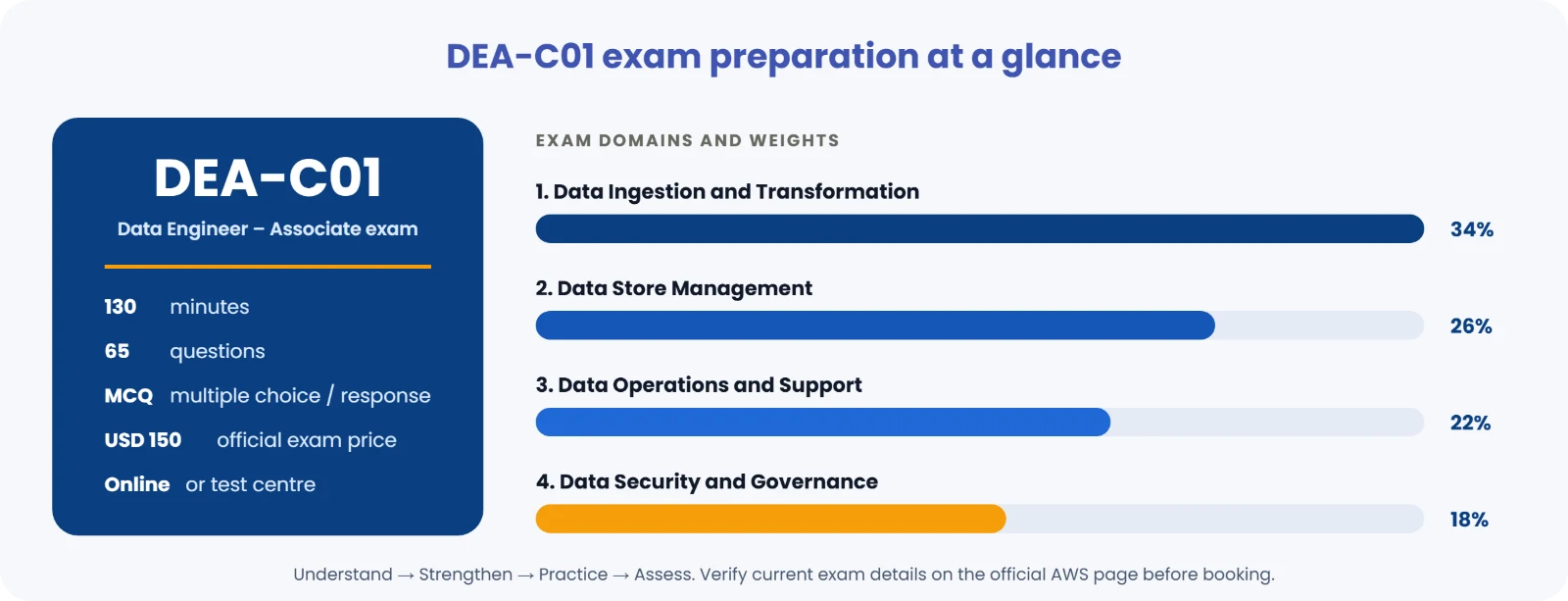
| Exam Duration | 130 Minutes |
| Number of Questions | 65 |
| Question Types | Multiple Choice and Multiple Response |
| Passing Score | 720 out of a scaled 100–1,000 |
| Exam Fee | USD 150 |
| Delivery | Online Proctored or Pearson VUE Test Centre |
| Certification Issuer | Amazon Web Services |
AWS exam requirements and pricing can change. Always check the official certification website before registering.
DEA-C01 Exam Domains and Weightage
| Exam Domain | Weightage |
|---|---|
| Data Ingestion and Transformation | 34% |
| Data Store Management | 26% |
| Data Operations and Support | 22% |
| Data Security and Governance | 18% |
The largest domain focuses on ingestion and transformation, so it’s particularly important to understand how data is collected and processed on AWS.
However, the other three domains also require attention. A working pipeline needs suitable storage, dependable operations, and strong security.
Review the official DEA-C01 exam guide to understand the exam tasks in more detail.
How to Prepare for the AWS Data Engineer Certification Exam
One of the most useful ways to prepare for DEA-C01 is to connect the theory with practical situations.
Suppose a question describes a business that needs to process events continuously. Instead of immediately looking for a familiar AWS service name, understand the requirements first.
Does the business need real-time processing? How much data is arriving? Does it need to retain the original events? What happens if the processing fails?
The answers help narrow down the right solution.
A preparation plan should cover the following areas:
- Review the four exam domains and the current AWS exam guide.
- Understand the AWS services used for each domain.
- Work through practical exercises.
- Practice selecting services for different business needs.
- Learn how to identify and troubleshoot common failures.
- Review security, monitoring, and cost considerations.
- Answer scenario-based practice questions.
- Use mock assessments to understand which topics need more revision.
You can also use official AWS Skill Builder DEA-C01 preparation resources alongside the course.
AWS Data Engineer Certification Cost in Hyderabad
Before enrolling, it’s important to understand that the training fee and official AWS certification exam fee are separate.
Certification Mantra Training Fee
This is the listed fee for the Certification Mantra AWS Data Engineer training program.
The course description includes instructor-led sessions, practical labs, projects, learning materials, mock questions, and certification preparation.
Contact the institute to confirm the current fee, applicable taxes, and payment arrangements before enrolling.
Official AWS Certification Exam Fee
AWS lists the DEA-C01 Associate-level examination at USD 150.
The amount payable in India may vary based on regional pricing, currency handling, and taxes.
The AWS certification exam fee is not included in the ₹24,999 training fee.
Course Completion Certificate vs Official AWS Certification
These two credentials serve different purposes.
Certification Mantra Course Completion Certificate
A Certification Mantra course completion certificate, where provided under the institute’s completion policy, records that you completed the training requirements.
AWS Certified Data Engineer – Associate
The AWS Certified Data Engineer – Associate credential is issued by Amazon Web Services after you pass the official DEA-C01 exam.
Finishing a training course does not automatically give you the AWS certification.
The purpose of the training is to help you understand the topics, develop practical skills, and prepare for the exam.
Career Opportunities After AWS Data Engineering Training
AWS data engineering skills can be useful in jobs that involve storing, processing, organizing, and delivering information through cloud services.
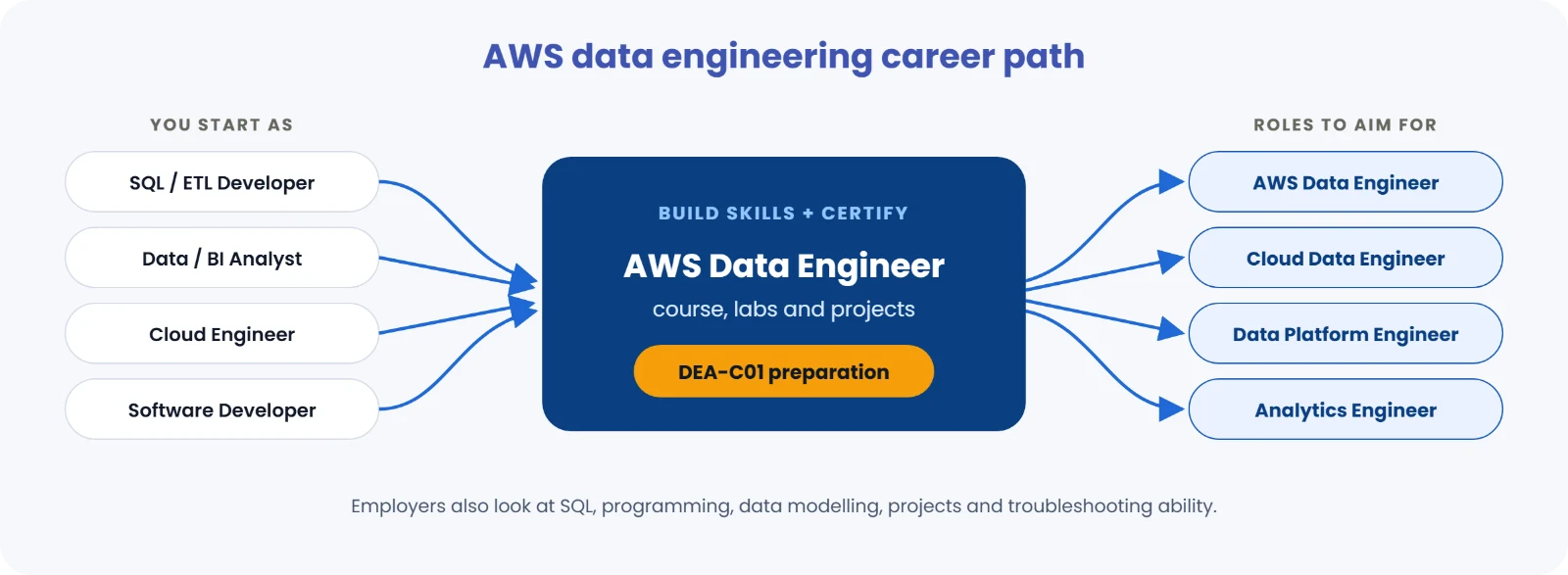
Depending on your existing experience, related roles may include:
AWS Data EngineerData EngineerCloud Data EngineerETL DeveloperData Platform EngineerBig Data EngineerAnalytics EngineerData Infrastructure Engineer
For example, someone with strong SQL experience may use AWS training to move toward cloud-based ETL work. A developer already working with AWS may expand into data pipelines and analytics platforms.
A certification can support your professional development, but employers also consider practical experience, projects, programming knowledge, SQL, problem-solving skills, and communication.
Completing the course or passing the exam does not guarantee employment.
Why Choose Certification Mantra for AWS Data Engineer Training in Hyderabad?
Choosing an AWS training course often comes down to a few practical questions.
Will the syllabus cover the topics you need? Will you get a chance to work with the services? Can you understand how they connect? Does the training help you prepare for DEA-C01?
At Certification Mantra, the published 40-hour course brings these areas together.
Learn AWS Data Engineering in a Structured Order
The course begins with foundational concepts before moving into data ingestion, transformations, storage, automation, operations, security, and governance.
Practice with AWS Services
The syllabus includes lab exercises using services such as Amazon S3, AWS Glue, Athena, Redshift, Kinesis, Lambda, IAM, and CloudWatch.
Understand Complete Data Pipelines
Projects show how services can work together rather than being treated as unrelated topics.
Prepare for DEA-C01
The curriculum follows the technical areas of the AWS Certified Data Engineer – Associate exam.
Choose Classroom or Live Online Learning
You can enquire about classroom training near JNTU in Hyderabad or attend live online sessions.
What Our Learners Say About Certification Mantra
Certification Mantra learner feedback from our homepage. These are general institute reviews, not reviews of this particular AWS Data Engineer course.
The learner appreciated the informative classes, discussions, and assignments, and said the overall training experience helped build useful practical understanding.
The learner highlighted the well-organized material, easy-to-follow presentation, knowledgeable instructors, and the opportunity to ask questions during training.
The learner described the training as practical and confidence-building, with useful guidance that supported preparation for real professional situations.
Certification Mantra Training Location in Hyderabad
Certification Mantra is located near JNTU in Hyder Nagar, Hyderabad.
Certification Mantra
3rd Floor, Dr Atmaram Estates
Beside Sri Bhramaramba Theatre
Near JNTU, Metro Pillar A689
Hyder Nagar, Vasantha Nagar
Hyderabad, Telangana – 500072
Phone: +91 9704179997
Email: certificationmantra@gmail.com
If you would like to attend classroom training, contact the team for the next available schedule.
AWS Data Engineer Certification Course in Hyderabad — FAQs
1. What is the AWS Data Engineer Certification Course in Hyderabad?
It’s an instructor-led course at Certification Mantra that covers AWS data engineering concepts, practical labs, projects, and preparation for the AWS Certified Data Engineer – Associate (DEA-C01) exam. The listed training options include classroom sessions in Hyderabad and live online classes.
2. How long is the AWS Data Engineer course?
The course duration is 40 hours. The calendar schedule depends on the batch timings, so contact Certification Mantra for the latest available schedule.
3. What is the AWS Data Engineer Certification Course fee in Hyderabad?
The listed training fee is ₹24,999. The official AWS certification exam fee is separate. Confirm the current fee and applicable taxes before enrolling.
4. What is the AWS Data Engineer Certification cost in India?
AWS lists the DEA-C01 Associate exam at USD 150. The actual amount payable in India may vary because of currency conversion, local pricing, and applicable taxes. Training costs are separate.
5. What is DEA-C01?
DEA-C01 is the exam code for AWS Certified Data Engineer – Associate. The exam covers data ingestion, transformation, storage, operations, security, and governance.
6. Can beginners learn AWS data engineering?
Yes, beginners can start learning the concepts. Basic SQL, programming, database knowledge, and cloud fundamentals will help. However, people without practical AWS experience may need additional preparation before taking DEA-C01.
7. Which AWS services are covered in this course?
The syllabus includes Amazon S3, AWS Glue, Redshift, Athena, Kinesis, EMR, Lambda, Step Functions, CloudWatch, IAM, KMS, and other relevant AWS data services.
8. Are practical projects included?
The course outlines four projects involving batch processing, real-time event data, serverless workflows, and a secure enterprise data lake.
9. Does the course include hands-on labs?
Yes. The published curriculum includes 12 lab exercises covering AWS storage, data ingestion, transformation, querying, automation, monitoring, and security.
10. Is live online AWS Data Engineer training available?
Yes. Certification Mantra lists live online sessions as an available training option. Contact the team for the next online batch and session timings.
11. Can I attend AWS Data Engineer classroom training in Hyderabad?
Certification Mantra lists classroom training near JNTU, Hyder Nagar. Confirm the current batch arrangements with the team before visiting.
12. Do I need SQL and Python to join?
Basic SQL knowledge is helpful, and some familiarity with Python can make data transformations easier to follow. You don’t need advanced programming knowledge to begin learning the fundamentals.
13. How many questions are in the DEA-C01 exam?
The official exam contains 65 questions, including multiple-choice and multiple-response questions.
14. What is the passing score for DEA-C01?
The passing score is 720 on AWS’s scaled score range of 100 to 1,000.
15. Can I take the AWS Data Engineer certification exam online?
Yes. AWS offers online-proctored testing and Pearson VUE test-centre options, subject to its current exam policies.
16. How should I prepare for AWS Data Engineer Certification?
Start with the official exam guide. Learn the AWS services covered in each domain, practice building data pipelines, and work through scenario-based questions. Mock assessments can help you identify topics that need further revision.
17. Will Certification Mantra award the official AWS certification?
No. The official AWS Certified Data Engineer – Associate credential is issued by Amazon Web Services after you pass DEA-C01. Certification Mantra provides training and exam-preparation support.
18. Is the AWS exam fee included in the training fee?
No. The ₹24,999 course fee and official AWS examination fee are separate.
19. Is AWS Data Engineer Certification worth pursuing?
It can be useful if you work with cloud data platforms or want to demonstrate knowledge of AWS data engineering services. The certification is more valuable when combined with practical experience, SQL, programming, and projects.
20. What career roles use AWS data engineering skills?
Related roles include AWS Data Engineer, Data Engineer, Cloud Data Engineer, ETL Developer, Data Platform Engineer, and Big Data Engineer. The role you qualify for depends on your skills and experience.
21. Is the course mainly theoretical?
No. The course description includes technical lessons, hands-on labs, projects, and DEA-C01 exam preparation.
22. Where is Certification Mantra located in Hyderabad?
The institute is on the 3rd Floor of Dr Atmaram Estates, near JNTU and Metro Pillar A689, Hyder Nagar, Hyderabad, Telangana 500072.
23. How can I join the next AWS Data Engineer batch?
Contact Certification Mantra at +91 9704179997 to ask about the next classroom or online batch, course schedule, fees, and enrolment arrangements.
Start Learning AWS Data Engineering with Certification Mantra
Understanding AWS data engineering is easier when you can see how the different services work together.
The AWS Data Engineer Certification Course in Hyderabad gives you a structured way to learn cloud data pipelines, practice using AWS services, work through practical projects, and prepare for the DEA-C01 exam.
Whether you’re already working with data or planning to build new cloud skills, you can choose the training option that suits your schedule.
Duration: 40 Hours • Course Fee: ₹24,999 • Training: Classroom / Live Online • Location: Near JNTU, Hyderabad • AWS Certification Exam Fee: Separate
Phone: +91 9704179997