
AWS Security Specialty Certified Training in Hyderabad
Prepare for the AWS Certified Security – Specialty Exam with Practical, Industry-Focused Learning
Next Batch: 26 september 2026
Practical AWS Security Training
Build practical security skills through hands-on labs and real-world scenarios covering IAM, encryption, monitoring, network security, data protection, and threat detection.
Certification-Focused Preparation
Prepare for the AWS Certified Security – Specialty exam with structured lessons, practice questions, mock tests, and expert guidance focused on key certification domains.
Experienced Trainers
Learn from experienced AWS trainers and develop the practical knowledge needed to secure cloud workloads, manage security controls, and follow AWS security best practices.
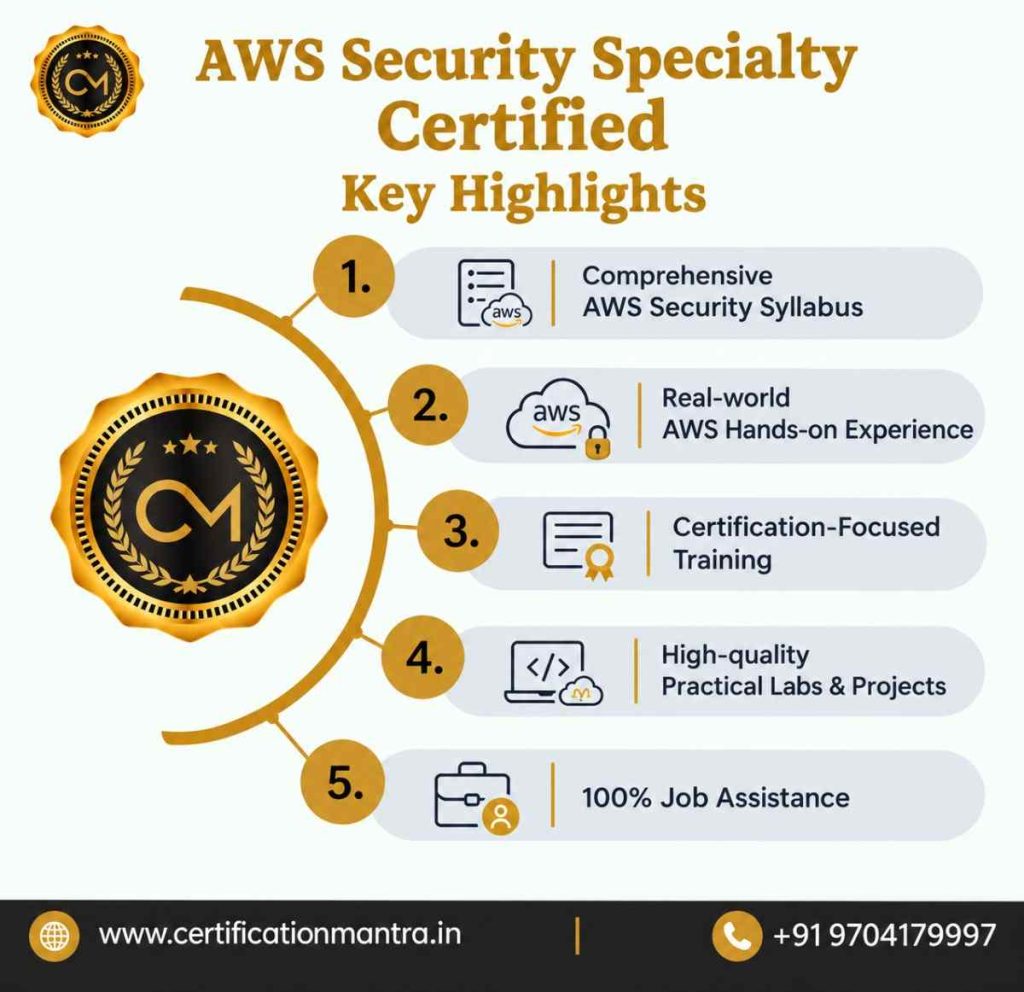
- Comprehensive AWS Security Specialty Syllabus
- Real-World AWS Security Hands-On Experience
- Certification-Focused Learning
- Lifetime Access to Recorded Lectures and Study Materials
- Practical Cloud Security Training
- Flexible Learning at Your Convenience
- Job Assistance for Relevant Cloud Security Roles
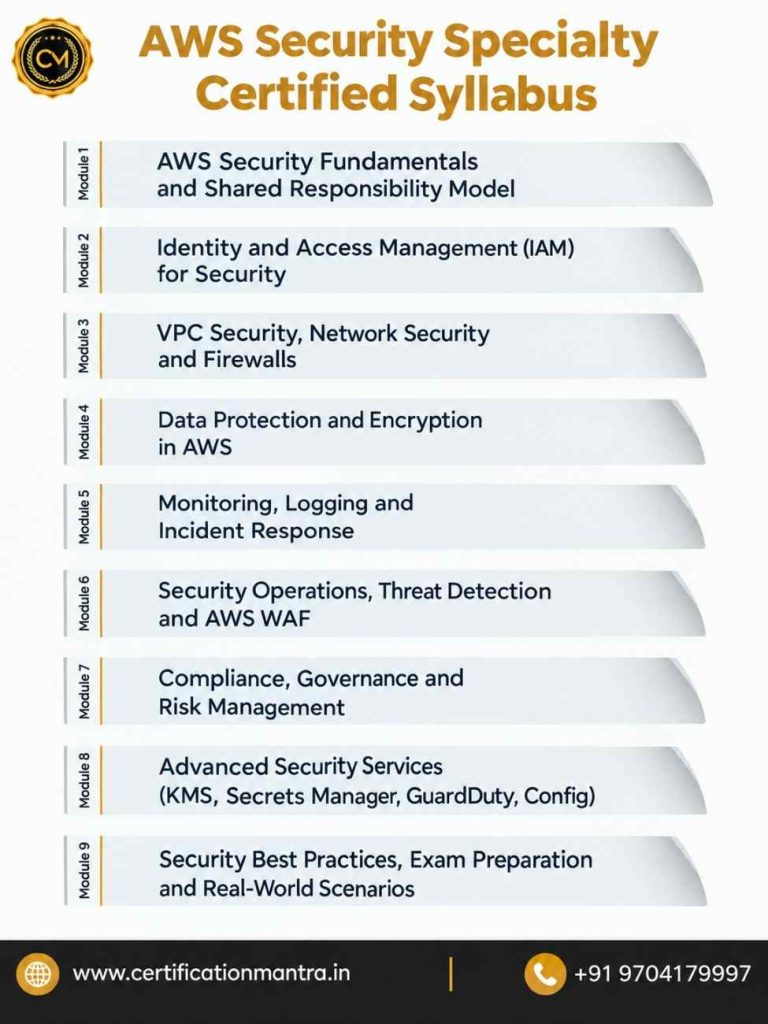
- AWS Security Fundamentals and Cloud Security Concepts
- AWS Shared Responsibility Model
- AWS Well-Architected Security Pillar
- AWS Security Best Practices
- AWS Regions, Availability Zones, and Global Infrastructure
- AWS IAM Users, Groups, Roles, and Policies
- Identity Federation and Access Management
- Multi-Factor Authentication (MFA)
- IAM Policy Evaluation and Permissions
- AWS Organizations and Service Control Policies
- AWS Key Management Service (KMS)
- AWS CloudHSM
- Data Encryption at Rest and in Transit
- Secrets Management with AWS Secrets Manager
- AWS Certificate Manager (ACM)
- Amazon VPC Security
- Security Groups and Network ACLs
- AWS WAF and AWS Shield
- VPC Endpoints and Private Connectivity
- Network Security Monitoring and Protection
- Amazon CloudWatch Security Monitoring
- AWS CloudTrail
- Amazon GuardDuty
- AWS Security Hub
- Amazon Detective
- Centralized Logging and Security Event Analysis
- Secure Application Architecture on AWS
- Amazon EC2 Security
- Amazon S3 Security
- AWS Lambda Security
- Container and Serverless Security
- Secure Configuration and Vulnerability Management
- AWS Security Governance and Policies
- AWS Organizations and Control Tower
- Compliance and Regulatory Requirements
- AWS Audit Manager
- AWS Config and Configuration Compliance
- Security Standards and Best Practices
- AWS Incident Response Fundamentals
- Threat Investigation and Analysis
- Security Incident Detection and Response
- Automated Security Response
- Security Event Investigation
- Incident Response Best Practices
- Real-World AWS Security Scenarios
- Security Misconfiguration Troubleshooting
- IAM and Access Control Scenarios
- Network and Data Security Challenges
- Threat Detection and Incident Response Scenarios
- End-to-End AWS Security Project Implementation
- Real-Time AWS Infrastructure Scenarios
- Application and Infrastructure Troubleshooting
- Monitoring and Performance Optimization
- Security and Access Issues
- Backup and Recovery Scenarios
- End-to-End AWS SysOps Project Implementation
AWS Certified Security – Specialty Exam Highlights
- It is a certification exam that validates your skills in securing AWS cloud environments.
- Tests your understanding of AWS security, identity management, data protection, and threat detection.
- Evaluates your ability to implement and maintain secure AWS cloud architectures.
- Focuses on access control, encryption, monitoring, incident response, and security best practices.
- Includes scenario-based questions related to real-world AWS security challenges.
- Assesses your knowledge of AWS services such as IAM, KMS, CloudTrail, GuardDuty, Security Hub, and WAF.
- Covers security monitoring, compliance, governance, vulnerability management, and incident response.
- Designed for professionals working in AWS cloud security and cybersecurity roles.
- Demonstrates your ability to identify, protect, monitor, and respond to security threats effectively.
- Helps professionals strengthen their credentials for AWS cloud security and cybersecurity roles.
AWS Certified Security – Specialty: Benefits
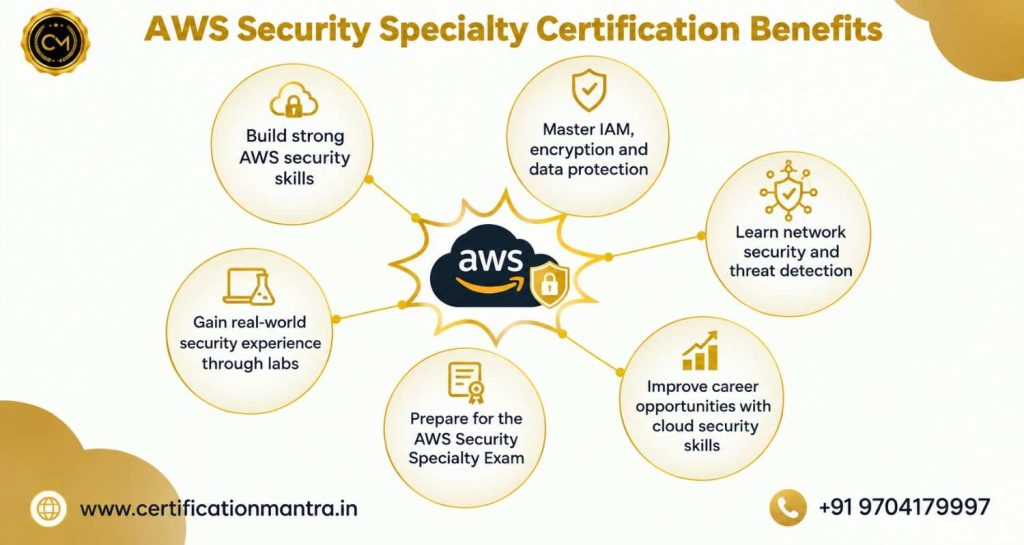
- Enables professionals to secure and protect AWS cloud environments effectively.
- Enhances cloud security through effective identity management, monitoring, encryption, and threat detection.
- Opens career opportunities in AWS security, cloud security, cybersecurity, and security engineering roles.
- Helps reduce security risks through structured access control, monitoring, and incident response practices.
- Builds proficiency in IAM, KMS, CloudTrail, GuardDuty, Security Hub, WAF, and other essential AWS security services.
- Increases your value to employers adopting AWS cloud infrastructure and security solutions.
- Strengthens your ability to implement reliable, scalable, and secure AWS cloud architectures.
- Helps you work confidently with AWS security, compliance, governance, and monitoring tools.
- Improves security operations through effective threat detection, incident response, and data protection strategies.
- Builds your AWS cloud security skills through practical training and certification preparation.
AWS Certified Security – Specialty Levels
There are different stages in the AWS Security learning journey, helping professionals build their knowledge from foundational cloud security concepts to advanced AWS security architecture, threat detection, and incident response. These levels are explained as follows:
Foundational (Beginner Level)
Learn the fundamentals of AWS cloud security and understand how security principles apply across AWS services. Explore identity, access management, data protection, network security, monitoring, and compliance concepts through practical examples. Get familiar with the AWS Shared Responsibility Model and essential security tools. Start working with services such as IAM, KMS, CloudTrail, S3, and Amazon VPC. Build the foundational knowledge required for AWS cloud security.
Intermediate (Practitioner Level)
Move into practical AWS security management by learning identity protection, encryption, security monitoring, vulnerability management, and access control techniques. Work with AWS CloudTrail, GuardDuty, Security Hub, AWS Config, and IAM to identify and manage security risks effectively. Practice configuring security controls, network protection, data encryption, and compliance solutions. Strengthen your ability to identify and respond to common cloud security challenges. Develop practical skills needed for professional AWS security roles.
Advanced (Expert Level)
Master advanced AWS security concepts through real-world cloud security scenarios and hands-on projects. Learn advanced threat detection, incident response, security automation, data protection, governance, and security architecture practices. Work with AWS security services and tools to design, implement, monitor, investigate, and optimize secure production environments. Apply security best practices to improve confidentiality, integrity, availability, compliance, and risk management. Build advanced skills aligned with modern AWS Cloud Security and cybersecurity roles.

Practical Security Labs
Practice AWS security configurations through hands-on exercises covering identity, encryption, network protection, monitoring, and threat detection.
Dedicated Learning Support
Get personalized assistance throughout your AWS security training, from understanding complex concepts to preparing for the certification exam.
Real-World Security Scenarios
Study practical cybersecurity situations and AWS security challenges to understand how security controls are applied in actual cloud environments.
Expert-Led Training
Learn from experienced instructors who explain AWS security concepts clearly and demonstrate how different security services work together.
Step-by-Step Certification Guidance
Receive structured guidance throughout your learning journey, including AWS security fundamentals, hands-on practice, exam preparation, and real-world security implementation.
Modes of Training
Online Training
- Beginner to advanced AWS Security training
- Live and recorded security-focused sessions
- Hands-on AWS security lab
- Real-world security project
- Certification exam preparation
- WhatsApp group access
Offline Training
- Beginner to advanced AWS Security training
- Lifetime access to recorded sessions
- Hands-on security lab practice
- One-to-one mentorship
- Real-time AWS security projects
- Real-time AWS security projects
Corporate Training
- Beginner to advanced AWS Security training
- Flexible batch timings
- Customized security learning sessions
- Live AWS security projects
- Hands-on security exercises
- Recorded learning resources
AWS Certified Security – Specialty Training – Objectives
- Understand the fundamentals of AWS cloud security and the shared responsibility model.
- Learn to implement secure, scalable, and resilient cloud environments.
- Develop practical knowledge of IAM, KMS, CloudTrail, GuardDuty, Security Hub, WAF, and other key security services.
- Monitor AWS environments and identify potential security threats, vulnerabilities, and unauthorized activity.
- Apply identity, access-control, encryption, and data-protection techniques across AWS workloads.
- Strengthen skills in network security, application protection, logging, monitoring, and security configuration.
- Use AWS security tools to investigate threats and support effective incident-response processes.
- Apply governance, compliance, auditing, and security best practices to cloud environments.
- Gain practical experience through real-world security scenarios, hands-on labs, and project-based exercises.
- Develop the knowledge and confidence needed to prepare for the AWS Certified Security – Specialty certification exam.
Career Growth After AWS Certified Security – Speci
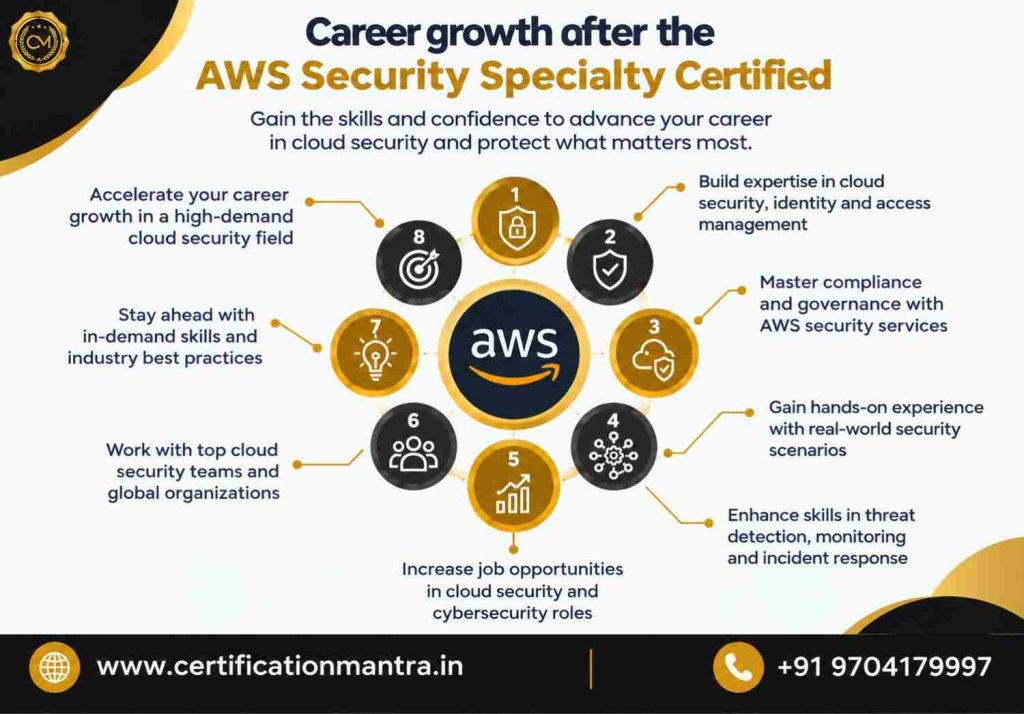
- Pursue roles such as AWS Security Engineer, Cloud Security Engineer, or Cloud Security Specialist.
- Explore career opportunities in cybersecurity, cloud infrastructure security, identity management, and security operations.
- Develop practical expertise in AWS identity, access control, encryption, threat detection, and security monitoring.
- Work with organisations that rely on AWS to protect applications, data, and cloud infrastructure.
- Strengthen your professional profile for positions involving cloud security architecture, risk management, and security operations.
- Expand your expertise into related areas such as DevSecOps, cloud architecture, compliance, and incident response.
- Gain practical experience securing AWS workloads across compute, storage, networking, and application environments.
- Demonstrate knowledge of AWS security services and industry-aligned cloud security practices to potential employers.
- Build a strong foundation for pursuing advanced cybersecurity certifications and progressing into senior cloud security roles.
Who Can Take AWS Certified Security – Specialty?
- Security Professionals who want to strengthen their expertise in protecting cloud environments.
- Cloud Engineers looking to develop stronger skills in identity, access control, and infrastructure protection.
- IT Professionals planning to move into cloud security or cybersecurity roles.
- DevSecOps Professionals seeking to improve their knowledge of security automation and secure application practices.
- Network and Infrastructure Professionals interested in securing AWS-based environments.
- System Administrators who want to expand their knowledge of access management, monitoring, and data protection.
- Technical Support Professionals looking to transition toward cloud security and security operations.
- IT Graduates with basic cloud or networking knowledge who want to start a career in cybersecurity.
- Working Professionals seeking to enhance their career profile with specialized cloud security expertise.
- Learners interested in gaining practical knowledge and preparing for the AWS Certified Security – Specialty examination.
How Can I Pass the AWS Certified Security – Specialty Exam?
- Begin by reviewing the current AWS Certified Security – Specialty exam guide and understanding its key knowledge areas.
- Build a strong foundation in IAM, KMS, CloudTrail, GuardDuty, Security Hub, WAF, and other important security services.
- Practice configuring identity controls, encryption, logging, monitoring, and secure access policies.
- Focus on network protection, data security, incident response, governance, compliance, and security operations.
- Gain hands-on experience by implementing security controls in practical AWS environments.
- Work through scenario-based questions involving threats, vulnerabilities, permissions, data protection, and security incidents.
- Create concise revision notes covering important services, security concepts, configurations, and best practices.
- Practice investigating security events and selecting appropriate solutions for real-world cloud security situations.
- Take regular mock exams to improve time management and identify topics that require additional preparation.
- Prepare consistently through hands-on labs, focused revision, practice questions, and realistic security scenarios.
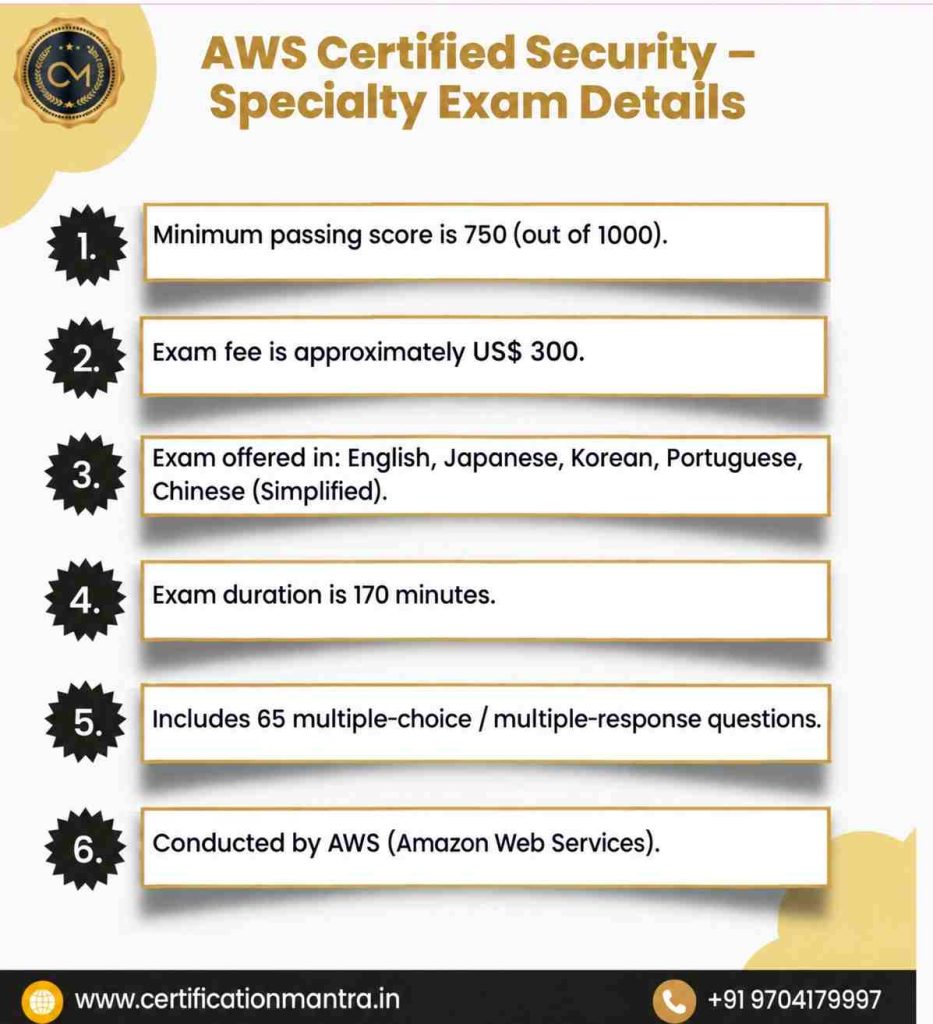
How to Take the AWS Certified Security – Specialty Exam?
- Create or sign in to your AWS Certification account to begin the examination registration process.
- Select the AWS Certified Security – Specialty certification from the available AWS certification exams.
- Choose an available delivery method, such as an online proctored exam or an approved testing center.
- Select a convenient examination date and time, then complete the required registration and payment steps.
- Review the current technical, identification, and testing requirements before scheduling an online examination.
- For remote testing, make sure your computer, webcam, microphone, internet connection, and testing environment meet the applicable requirements.
- Complete the required identity verification and check-in procedures before starting the examination.
- Read the examination instructions carefully and manage your time effectively throughout the test.
- Review your answers where permitted and submit the examination within the allotted time.
AWS Certified Security – Specialty Exam Cost?
- The AWS Certified Security – Specialty examination has a certification fee determined by AWS.
- The amount payable can differ depending on your country, currency, and applicable taxes.
- AWS may update examination pricing, so verify the current fee before completing your booking.
- Eligible candidates may receive certification benefits or discounts based on their AWS Certification account and previous certifications.
- Regional taxes or additional charges may be added during the payment process.
- Training providers may offer separate packages covering instructor-led training, practice tests, hands-on labs, and exam preparation.
- Course fees and the official examination charge are normally separate unless a provider clearly states that the exam is included.
- Candidates who need another attempt must follow the applicable AWS retake policy and pay the required examination fee.
- Some employers may reimburse or sponsor certification expenses as part of professional development programs.
- Always confirm the latest examination pricing and registration information through the official AWS Certification website before scheduling your test.
AWS Certified Security – Specialty Exam Retake Policy
Candidates who do not pass the AWS Certified Security – Specialty examination can schedule another attempt by following the current AWS Certification retake requirements.
Each examination attempt requires a separate booking, and the applicable examination fee may be charged unless an eligible voucher or certification benefit covers the cost. Candidates should also follow any required waiting period before registering for another attempt.
AWS applies specific testing, identity verification, security, and examination-proctoring requirements to every attempt. Since certification policies, fees, and retake conditions may change, candidates should review the latest official AWS Certification policies before booking a subsequent examination.
If you do not pass on your first attempt, use the results to identify areas that need improvement. Revising security concepts, practicing AWS security services, completing hands-on labs, and taking realistic mock tests can help strengthen your preparation before attempting the examination again.
Candidates who successfully earn the certification should follow the applicable AWS requirements when maintaining or renewing their certification status.
AWS Certified Security – Specialty Exam Cancellation Policy
Before scheduling the examination, candidates should review the current AWS Certification cancellation and rescheduling requirements that apply to their selected testing method.
- Check the applicable cancellation and rescheduling timeframe before confirming your examination appointment.
- Requests made close to the scheduled examination may be subject to specific AWS or testing-provider conditions.
- Failing to attend a scheduled appointment can have consequences for the examination fee or appointment status.
- Any voucher, discount, or promotional benefit used during registration remains subject to its applicable terms and conditions.
- Confirm the examination date, time, delivery method, and testing location carefully before completing your booking.
- Candidates taking the examination remotely should also review any additional requirements that apply to online-proctored appointments.
- Avoid unnecessary changes to your appointment by planning your examination schedule in advance.
- Follow the latest instructions provided by AWS Certification and the authorized testing provider when cancelling or changing an appointment.
- Reviewing the applicable policy in advance can help candidates avoid unexpected fees, appointment issues, or loss of eligible examination benefits.
What Our Students Say
Frequently Asked Questions

- AWS Certified Security – Specialty is an AWS certification that validates knowledge and skills in securing AWS workloads, managing access, protecting data, monitoring threats, and responding to security issues.
- It helps demonstrate practical knowledge of cloud security concepts and AWS security services to employers and organizations.
- A basic understanding of cloud computing, networking, operating systems, security concepts, and AWS services can be helpful.
- AWS Identity and Access Management (IAM) helps control access to AWS resources by managing users, roles, permissions, and policies.
- AWS Key Management Service (KMS) helps create and manage cryptographic keys used to protect data and other AWS resources.
- AWS CloudTrail records user and service activity within an AWS environment, helping with auditing, monitoring, and security investigations.
- Amazon GuardDuty is a threat detection service that continuously analyzes AWS activity and data sources to identify potential security threats
- AWS Security Hub provides a centralized view of security findings and helps organizations monitor their security posture across AWS environments.
AWS WAF is a web application firewall that helps protect applications from common web-based attacks and unwanted traffic.
- The difficulty depends on your existing knowledge of AWS, networking, and cybersecurity. Hands-on practice can make advanced security concepts easier to understand.
- Learners can work with the AWS Management Console, CLI, IAM, KMS, CloudTrail, GuardDuty, Security Hub, WAF, AWS Config, and other security services.
- Yes. Encryption and data protection are important areas, including concepts related to encryption at rest, encryption in transit, and key management.
- AWS Secrets Manager helps securely store, manage, and retrieve sensitive information such as application credentials, passwords, and API keys.
- Yes. Cloud security includes network protection concepts such as security groups, network ACLs, VPC configurations, private connectivity, and traffic filtering
- Amazon Macie helps discover and protect sensitive data stored in Amazon S3 by using automated data discovery and security analysis.
- AWS Shield provides protection against distributed denial-of-service (DDoS) attacks for applications running on AWS.
- Learners with basic knowledge of cloud computing, networking, and security can start preparing, although prior AWS experience can make the concepts easier to understand.
- Advanced programming skills are not necessarily required, but familiarity with scripting, command-line tools, and basic automation can be useful.
- Preparation time varies according to your existing AWS and security knowledge, study schedule, practical experience, and familiarity with the certification objectives.
- Relevant career paths can include Cloud Security Engineer, AWS Security Engineer, Cloud Security Specialist, Security Analyst, and other cloud cybersecurity roles.
- Yes. Hands-on practice can help you understand how security services, access controls, encryption, monitoring, and incident-response techniques work in real environments
- Yes. Beginners can start with cloud and security fundamentals and gradually progress toward more advanced AWS security concepts.
- Yes. AWS security knowledge can support DevSecOps practices by integrating security controls into application development, deployment, monitoring, and automation.
- Incident response involves identifying, investigating, containing, and responding to security events affecting AWS resources and workloads.
- Strong cloud security practices can help organizations protect sensitive information, control access, detect threats, meet compliance requirements, and reduce security risks.
- Training can provide structured learning, hands-on exercises, security-focused scenarios, certification preparation, and instructor guidance for learners preparing for the examination.
- AZ 900 Certification Training
- AZ 104 Certification Training
- DP 900 Certification Training
- DP 203 Certification Training
- PL300 Certification Training
- PSM1 Certification Training
- PSM2 Certification Training
- ITIL v4 Certification Training
- Salesforce Admin Certification Training
- Snowflake Core Certification Training
- ISTQB Certification Training