

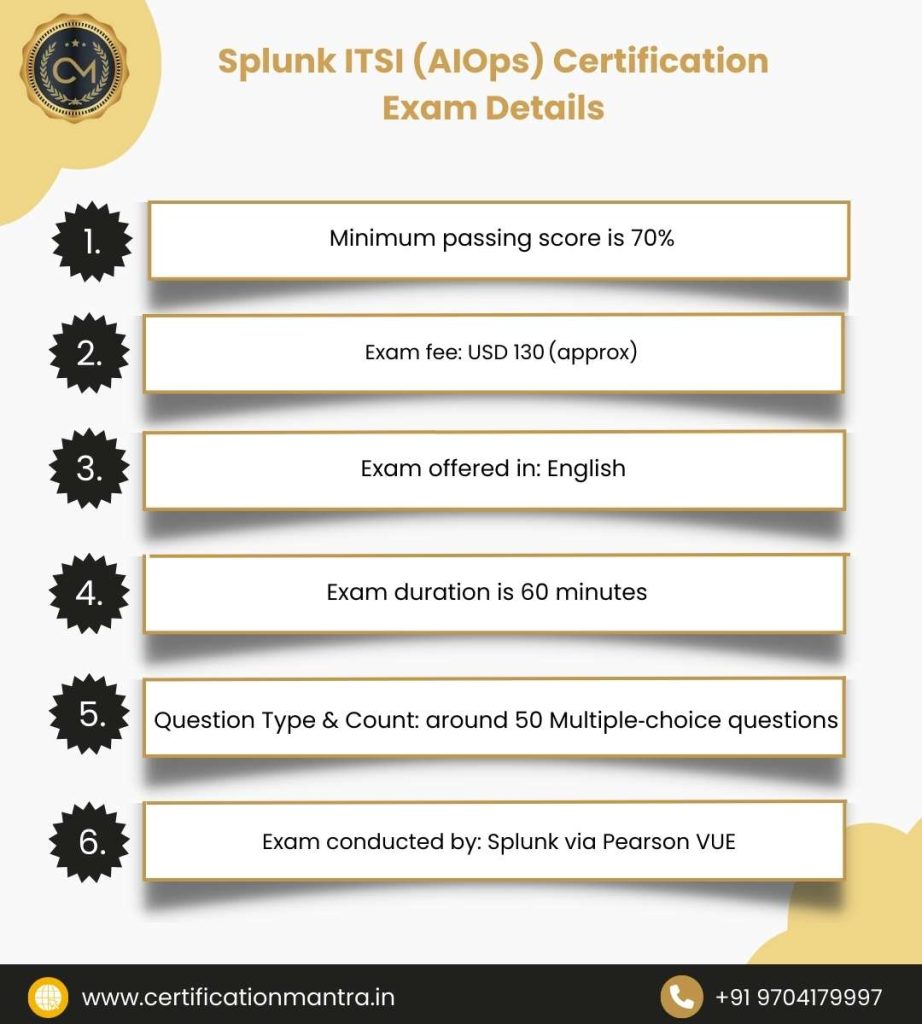
- Register on the official Splunk certification portal.
- Choose the ITSI (AIOps) certification exam option.
- Verify eligibility and prerequisites.
- Schedule a convenient exam date and time.
- Ensure a stable internet connection for online proctored exams.
- Prepare your exam workspace (quiet and distraction-free).
- Review all study materials from Splunk ITSI (AIOps) Certification Training in Hyderabad.
- Follow exam rules and ID verification procedures.
- Attempt questions carefully and track time.
- Receive results and certification digitally after passing.
Frequently Asked Questions

AI-driven IT monitoring solution.
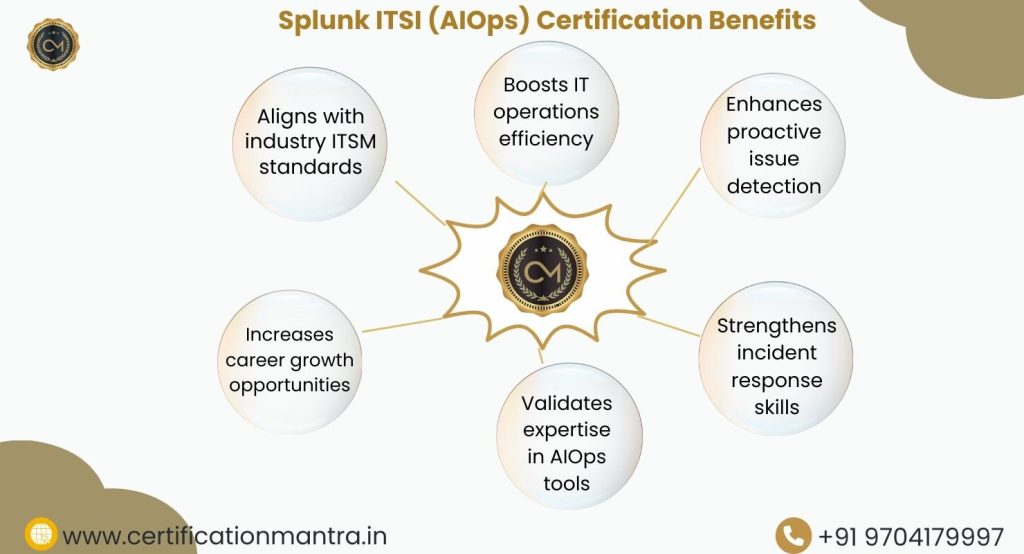
Detects issues early and improves efficiency.
Supports predictive analytics and smarter incident response.
IT professionals, DevOps engineers, and SREs.
Anyone managing complex IT systems.
Ideal for career growth in observability and AIOps.
Basic IT operations knowledge recommended.
Familiarity with Splunk dashboards.
Hands-on exposure via training advised.
Typically 30–40 hours.
Includes theory, labs, and practical exercises.
Flexible schedules for working professionals.
Usually online and proctored.
Can be taken from home or office.
Stable internet and quiet environment required.
Three levels: fundamental, intermediate, and advanced.
Each builds on the previous one.
Skills progress progressively across levels..
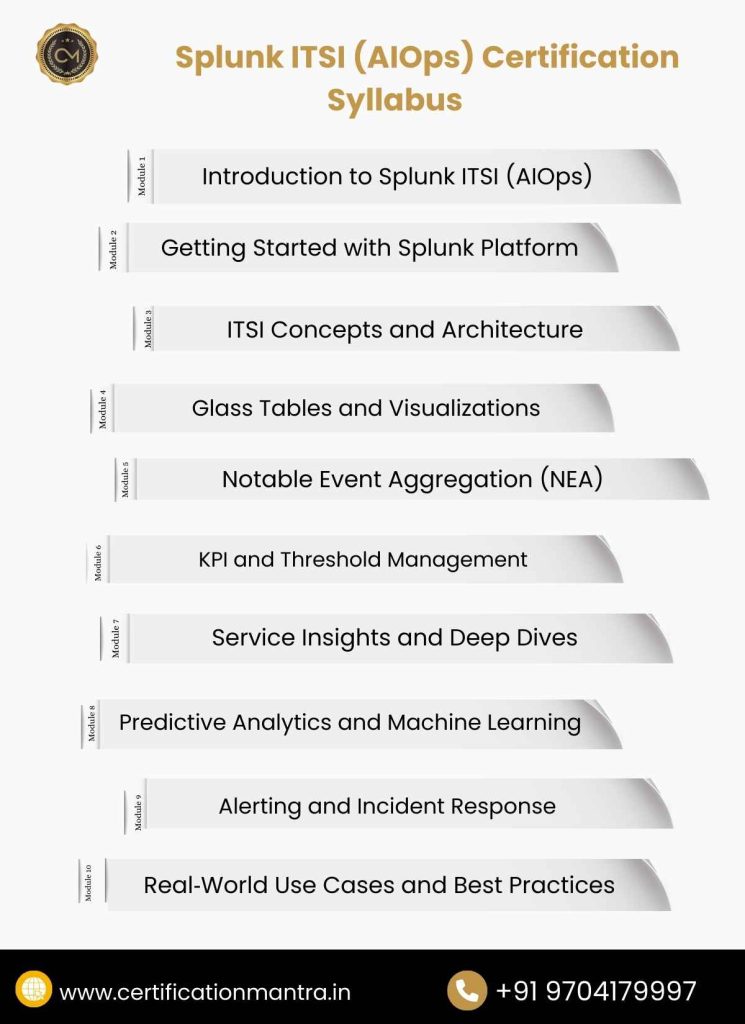
KPIs, Glass Tables, NEA, predictive analytics, and alerting.
Incident management and service mapping included.
Real-world scenarios are tested.
Typically 70–80% required.
Retakes allowed if you fail.
Practical exercises improve your score.
Yes, retakes are permitted after a short waiting period.
A separate retake fee applies.
Review weak areas before attempting again.
Yes, recognized internationally.
Valued by IT operations and AIOps employers.
Enhances professional credibility in observability expertise.
Approx. $150–$300 USD per attempt.
Retake fees around $100–$200 USD.
Costs vary by region.
Labs simulate real IT environments.
Practice KPIs, NEA, dashboards, and incident management.
Hands-on practice boosts exam readiness.
Groups related alerts into a single notable event.
Reduces alert noise significantly.
Helps teams focus on critical incidents faster.
- Visual dashboards in ITSI.
Display service health and KPI metrics.
Useful for real-time monitoring and decision-making.
- Uses machine learning models for anomaly detection.
Predicts issues before they impact services.
Improves uptime and reliability.
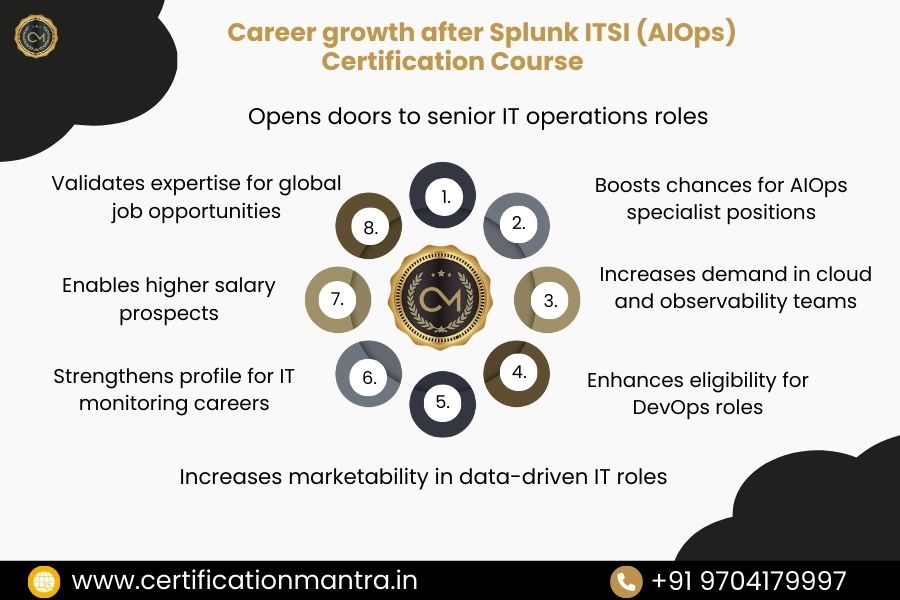
- AIOps Engineer, ITSI Specialist, DevOps Analyst, and SRE.
Roles vary by organization size.
Certification boosts credibility for promotions.
Typically valid for 2–3 years.
Renewal may require updated training or re-exam.
Check official Splunk policy for details.
Not mandatory but recommended.
Helps in understanding KPIs and dashboards.
Beginners may need extra practice.
- Yes, flexible online classes and self-paced labs.
Evening or weekend batches are common.
Hands-on exercises are key.
Automated alerting and event correlation.
Reduces MTTR significantly.
Supports structured incident response planning.
Many providers offer practice tests.
Simulate real exam conditions.
Boost confidence and readiness.
Maps services to business outcomes.
Aligns IT monitoring with business objectives.
Improves decision-making.
- Finance, telecom, healthcare, IT services, and cloud.
Any industry with complex IT systems benefits.
AIOps adoption is growing rapidly.
Digital badge issued upon passing.
Can be shared on LinkedIn and resumes.
Verification via official Splunk portal.
Certified professionals often get higher pay.
Employers value ITSI and AIOps expertise.
Demonstrates practical skills.
Practice grouping alerts and creating aggregation rules.
Review sample scenarios from training.
Hands-on exercises improve understanding.
- Supports hybrid and multi-cloud environments.
Tracks services in AWS, Azure, and GCP.
Improves observability in distributed IT setups.
Fundamentals level is beginner-friendly.
Advanced levels require more experience.
Structured training guides learners gradually.
Integrates with ticketing, monitoring, and cloud tools.
Examples: ServiceNow, AWS CloudWatch, Nagios.
Enhances workflow and automation.
- Immediately after completing training.
Hands-on practice boosts readiness.
Schedule via the official Splunk portal.