

Enlist via AWS’s authorized credentialing console with an active profile.
Select the DVA-C02 cloud developer test key relative to the current version.
Select your desired test window and confirm hardware compatibility criteria.
Finalize the transaction utilizing the AWS Training and Certification Portal.
Sit the test remotely utilizing AWS’s supervised testing platform.
Confirm your camera, mic, and computer satisfy test specifications.
Adhere to personal verification protocols during test log-in.
Send responses inside the allocated timeframe and recheck if scale permits.
Save your report and cloud credential following passing the test triumphantly.
Frequently Asked Questions

- It is a globally recognized credential that validates your technical expertise in developing, deploying, and maintaining cloud-based applications on Amazon Web Services. The training covers core AWS services, security best practices, and serverless application design patterns.
- It demonstrates your proficiency in building cloud-native applications, making you highly competitive in the modern IT job market. Certification opens up advanced technical career paths and significantly increases your earning potential globally.
- You should have a foundational understanding of core IT services and a basic familiarity with at least one high-level programming language like Python, Java, or JavaScript. Prior exposure to web application development and cloud computing concepts is highly beneficial.
- Identity and Access Management (IAM) policies are JSON documents that explicitly define permissions and access controls for users, groups, or roles. They determine exactly which actions can be performed on specific AWS resources to ensure robust security.
- AWS Lambda is a serverless, event-driven compute service that lets you run code without provisioning or managing servers. It automatically scales your application up or down while charging you only for the exact compute time consumed.
- It is an architectural method focused on designing, building, and running applications designed fully to leverage cloud flexibility and scalability. It relies heavily on microservices, continuous integration/continuous deployment (CI/CD) pipelines, containers, and serverless systems.
- This training is ideal for software developers, system engineers, and IT professionals who want to transition into or advance in cloud-focused development roles. It is also perfect for technical graduates aiming to enter the cloud ecosystem with a strong credential.
- It can be challenging due to its vast technical syllabus, but it is entirely manageable with structured training and hands-on laboratory practice. Gaining direct experience with real-world scenarios on the AWS console simplifies the core learning curve.
- You will need an active AWS Free Tier account, an integrated development environment (IDE) like VS Code or AWS Cloud9, and the AWS Command Line Interface (CLI). Familiarity with SDKs for your chosen programming language is also necessary.
- While “SQLScript” is native to SAP, in an AWS context, this refers to executing structured query logic inside cloud databases like Amazon RDS or Amazon Athena. It involves writing standardized queries and stored procedures tailored for high-performance cloud data layers.
- Annotations in cloud architectures involve using metadata tags or code declarations to configure resource behaviors, API endpoints, or database structures automatically. Tools like AWS SAM or CloudFormation templates use them to seamlessly deploy managed cloud components.
- The training teaches you to implement highly optimized caching solutions through Amazon ElastiCache and distribute content via Amazon CloudFront. It also guides you in choosing the correct elastic compute and database configurations to match app traffic.
- AWS Development Tools is a comprehensive suite of cloud services designed to manage your application lifecycle automatically. Key components include AWS CodeCommit for repository hosting, CodeBuild for compilation, and CodeDeploy for release automation.
- No, AWS Serverless architecture natively uses standard web-centric development programming languages such as Node.js, Python, Java, Go, C#, and Ruby. It operates completely independently of proprietary enterprise languages like SAP ABAP.
- In an AWS data framework, a calculation view translates to building complex, analytical data models using services like Amazon Redshift or AWS Glue. It allows developers to aggregate and transform vast operational data sets for business intelligence tools.
- While taking the training does not legally mandate booking the official exam, earning the formal AWS certificate is highly recommended. The actual credential formally validates your skills to hiring managers and enterprise tech firms.
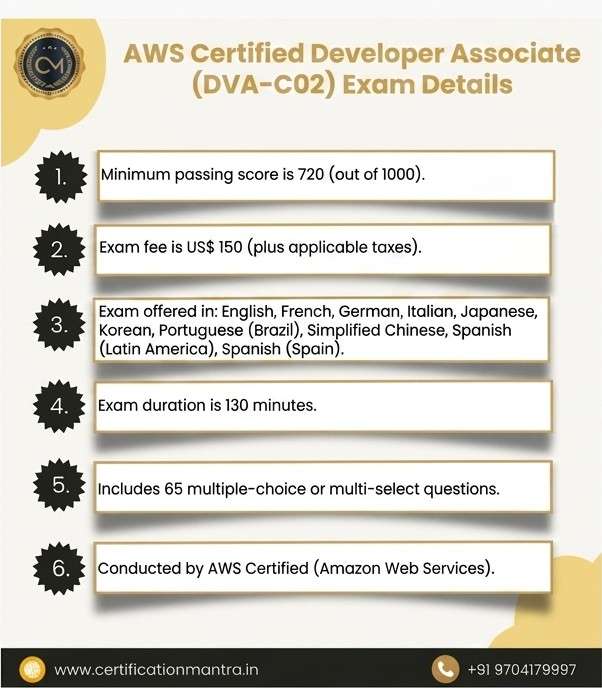
- The DVA-C02 exam consists of 65 multiple-choice or multi-select questions to be completed within 130 minutes. It evaluates practical proficiency across critical areas like cloud security, development with services, deployment, and troubleshooting.
- With dedicated, structured training, it typically takes 6 to 8 weeks to comfortably master the core certification syllabus. This timeline depends on your prior programming background and the hours spent practicing inside real lab environments.
- Yes, as global enterprise infrastructure rapidly migrates away from on-premise systems, cloud skills are in permanent demand. AWS dominates the global market share, securing long-term career stability for qualified engineers.
- You will qualify for highly sought-after professional titles including Cloud Developer, DevOps Engineer, Full-Stack Cloud Engineer, and Application Architect. It also opens up doors to technical leadership tracks within global IT operations.
- Virtually every modern industry uses AWS, ranging from global financial services and e-commerce platforms to healthcare, entertainment, and government sectors. Any business building software or managing digital transformation relies heavily on certified cloud professionals.
- Yes, the AWS Command Line Interface (CLI) is an essential tool that lets you control and automate services directly from your terminal. Mastering it allows developers to build efficient, repeatable deployment scripts and manage cloud infrastructure rapidly.
- Yes, modern serverless web dashboards and data visualization tools like Amazon QuickSight are replacing legacy corporate reporting frameworks. They provide much faster, real-time analytics and global accessibility without the constraints of on-premise application layers.
- While you can manage basic compute infrastructure using pre-built console wizards, writing database application logic demands core SQL skills. SQL is fundamental for querying data effectively across any cloud relational database system.
- In cloud database services like Amazon Athena or Redshift, table functions are user-defined operations that return data in a tabular layout. They allow developers to execute complex, parameterized data transformations directly inside query pipelines.
- AWS offers specialized data migration tools and serverless frameworks that smoothly port legacy systems into modern cloud microservices. This migration effectively eliminates on-premise hardware upkeep, slashes operational overhead, and enables automated auto-scaling.
- It involves analyzing cloud application execution using monitoring metrics from Amazon CloudWatch and X-Ray to find compute blockages. Tuning includes right-sizing server profiles, optimizing read/write throughput, and implementing efficient caching systems.
- Yes, freshers can absolutely undertake this learning path, provided they possess a foundational understanding of basic programming principles. It serves as an excellent accelerator to enter the corporate technology workspace with modern, highly relevant skills.
- Practical training is completely vital since the official DVA-C02 examination focuses intensely on scenario-based problem solving. Without directly configuring real services and testing setups in live sandboxes, passing the certification is exceptionally difficult.
- AWS offers a broader, globally versatile ecosystem across every modern sector, whereas ABAP binds your technical career strictly within SAP applications. Cloud architectures afford wider job options, higher developer flexibility, and superior future technological growth.